
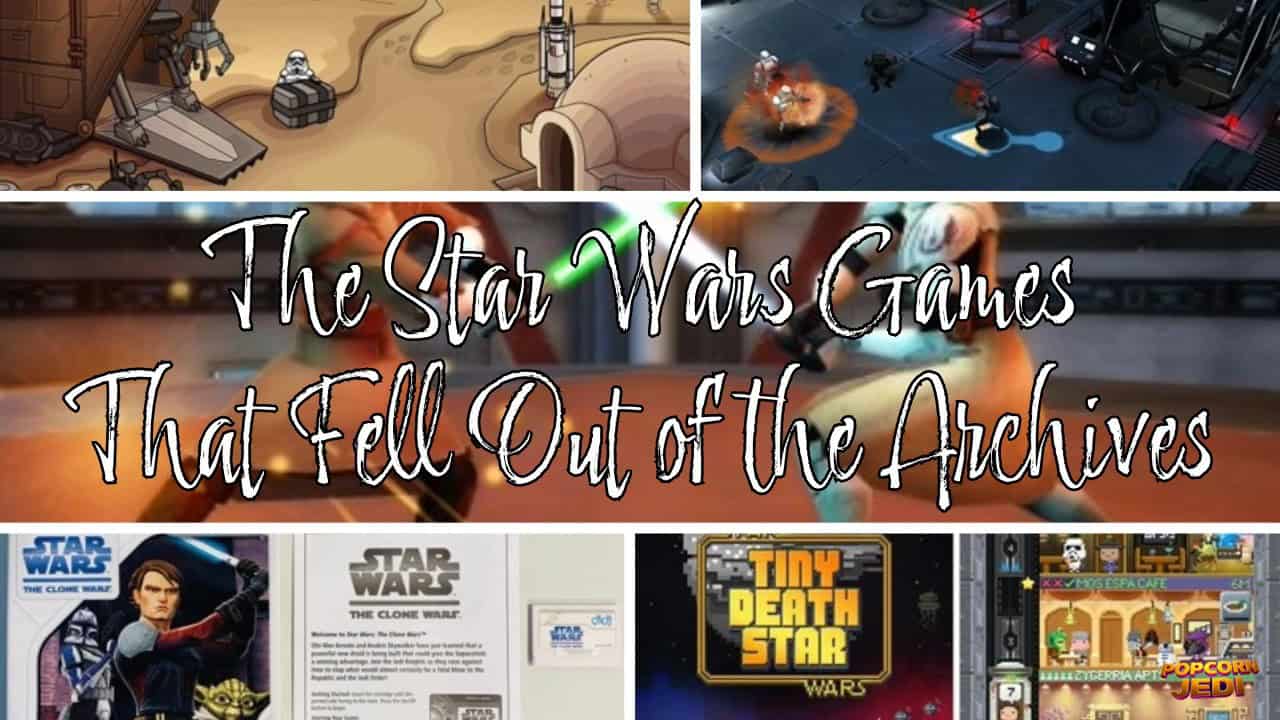
A guest feature exploring the forgotten corners of Star Wars gaming history, where cartridges survive, browser worlds disappear and entire games can vanish when the servers go dark.
Written for Popcorn Jedi by Søren Kamper, documenting overlooked releases and the preservation problems surrounding lost, delisted and server-dependent Star Wars games.
|
The Star Wars Games |
|---|
| From short-lived browser adventures to mobile worlds lost behind a server shutdown, the galaxy has a preservation problem far stranger than a missing cartridge.
Guest feature by Søren Kamper of Star Wars: Gaming In July 2013, Darth Vader arrived on Club Penguin. He did not conquer Coruscant, crush the Rebel Alliance or deliver a particularly memorable speech. He came to an island of waddling children, decorated rooms and collectible outfits. For three weeks, the familiar online playground became a Star Wars adventure, complete with lightsaber duels, a Death Star and an Imperial villain called Darth Herbert. There were 18 themed rooms and three new minigames. Disney itself counted them in a contemporary interview. Then the event ended, and the island returned to being an island.
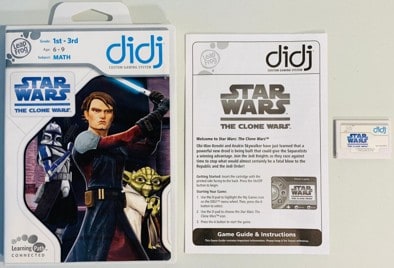
Tatooine in Club Penguin’s limited-time Star Wars Takeover (2013). It is tempting to file the whole affair under “marketing” and move on. But that would overlook an awkward question. If a person spent an evening infiltrating a space station as a penguin, where does that part of Star Wars history belong now? It is not on a cartridge. You cannot put the event back on a shelf. A screenshot may show Darth Herbert, but it cannot recreate the feeling of joining hundreds of other players who were all briefly inhabiting the same very silly corner of the galaxy. The question matters to a site such as Popcorn Jedi, whose Star Wars Screen Timeline and Publishing Timeline preserve the relationships between stories across different media. Games need that care too, perhaps even more urgently. A novel can vanish from shops and still survive in a library. A game may require a particular browser, a specific telephone, a discontinued service or a server that no longer answers. Sometimes the title survives more easily than the thing it names. When a browser tab was part of the galaxyBefore the mobile boom, official StarWars.com visitors could stop reading the news and play something. In the early 2000s, Force Flight, Garbage Masher and Carbon Connection offered three miniature diversions. Force Flight compressed famous cinematic escapes into a browser window. Carbon Connection tested memory and knowledge. Garbage Masher turned trivia into a trash-compactor emergency: answer incorrectly, and the walls moved closer to Luke, Leia, Han and Chewbacca. The films had spent fortunes putting those characters in danger. A website managed the same basic anxiety with a quiz. Two things can be true about these little games. They were minor attractions beside the major Star Wars games of the period. They also reveal what the Star Wars internet once was: not merely a delivery system for trailers, but a place to play. Some contemporary captures and later preservation work can document their appearance and mechanics. That does not mean that clicking an old web link today reliably produces the original experience. A decade later, the internet was a different machine, but the appetite for short-lived games remained. The Club Penguin Star Wars Takeover of 2013 was an event inside an existing virtual world, not a standalone Star Wars title. The distinction matters: its game rules, social spaces and temporary scenery belonged to a particular moment in a larger service. The official Disney interview with producer Adam Semeniuk survives; the event itself does not return simply because its announcement is still readable. The same year, LEGO tried something less theatrical. LEGO Star Wars: The Yoda Chronicles brought small squad-command missions to phones, with a browser companion promoted for Star Wars Day. Its 2014 successor, The New Yoda Chronicles, changed the formula into a collection of action minigames, with separate mobile and browser releases. They were not interchangeable versions of one enormous LEGO adventure. They were particular products of an era when brands scattered small experiments across web portals and app stores. If an archive folds both games into a single entry because their titles sound alike, a piece of design history goes missing before any software has even been lost. A cartridge, a download and a trapdoorThere is an instructive physical exception. In 2008, LeapFrog released Star Wars: The Clone Wars for the Didj, a handheld educational action game in which Anakin Skywalker could be stopped by mathematics. It had its own cartridge, its own hardware requirements and an Ultra Droideka whose military planning apparently left room for fractions. The separate Jedi Math for Leapster was not the same game on another machine. Both illustrate a valuable archival habit: photograph the real object, identify the actual platform, and resist the urge to turn vaguely related releases into one title.
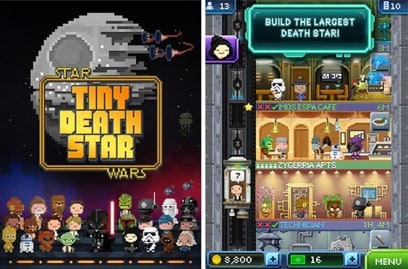
Star Wars: The Clone Wars for the LeapFrog Didj (2008): original packaging, instructions and cartridge. A working Didj and a cartridge may still be found, examined and photographed. This is not the same preservation challenge as a browser event that depended on a vanished service. But it is hardly simple. Software histories often survive as cover art and catalogue records while the hardware, manuals and footage needed to understand how they played grow scarce. “Available on an old cartridge” and “conveniently playable today” are not synonyms. A dusty handheld cannot be launched by tapping the Install button. Phones made that trapdoor a business feature. In November 2013, Disney Mobile launched Star Wars: Tiny Death Star, an affectionate pixel-art management game in which the Empire’s superweapon somehow acquired restaurants, apartments and staffing problems. The following March, Star Wars: Assault Team offered a very different portable pleasure: Han Solo and other familiar faces fighting their way through staged encounters in a collectible-card squad adventure. Neither was simply the console version made smaller. Both were attempts to invent the kind of Star Wars that belonged on a phone.
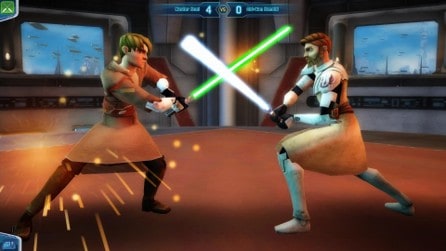
Tiny Death Star (2013) transformed the Empire’s ultimate weapon into a pixel-art building game. By October 2014, both had been removed from major app stores. The contemporary reporting is unusually clear. Contemporary reporting said the removals were intended to focus on newer mobile Star Wars games, including Star Wars: Commander; Ian Marsh of NimbleBit, which had collaborated on Tiny Death Star, said his studio had received no timeline before the withdrawal. That distinction deserves care: removal from a storefront is not identical to instant technical death. Some previously installed copies could still run at the time. But new players had lost the straightforward path into the game, and updates and support were another matter. The shelf was not merely empty; the shopkeeper had changed the rules. When the server owns the last copyThe harshest lesson arrived with worlds that could not function without the company operating them. Star Wars: Clone Wars Adventures, launched by Sony Online Entertainment in 2010, invited fans into a shared universe of minigames, costumes, social spaces and short activities. It was a place to inhabit between episodes of the television series, rather than a conventional campaign with a final boss and credits. Contemporary reporting recorded Sony Online Entertainment’s announcement that the service would close on 31 March 2014. A video of an old character-customisation screen can tell us how the world looked; it cannot bring back the other people who once filled it.
A lightsaber duel in Clone Wars Adventures, the online Star Wars world that closed in 2014. Konami’s Star Wars: Force Collection from 2013 put the films into a growing deck of digital characters, formations and online battles. Its service closed on 23 April 2018. Star Wars: Commander, launched in 2014, turned the conflict between Rebels and Imperials into years of base construction, upgrades and asynchronous skirmishes before its own servers closed on 12 June 2020. These games were more than static applications. They changed through updates, economies, special events and the habits of the people playing them. A launch-day screenshot captures only the opening chapter. Contemporary closure announcement. Contemporary closure announcement. Then there is Star Wars: Uprising. Released in September 2015, Kabam’s action RPG placed its story in the uneasy aftermath of Return of the Jedi. The Emperor was dead, but the Anoat Sector’s Imperial governor preferred that nobody receive the news. It was an appealing idea for a smaller, less aristocratic Star Wars story: smugglers, blockades and ordinary people trying to work out which government was lying to them. Alexander Freed, known to players of The Old Republic for the Imperial Agent storyline, wrote the script. Daniel Erickson, another Old Republic veteran, served as Director of Design. 2015 interview.
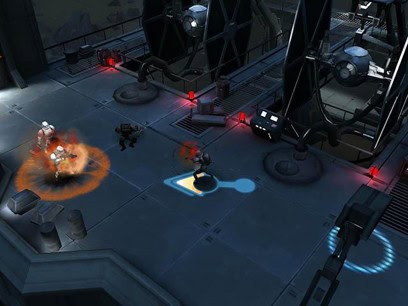
Combat in Star Wars: Uprising (2015), whose online servers closed in 2016. Contemporary reporting on Kabam’s announcement said that Uprising’s servers would shut down on 17 November 2016, little more than a year after the game reached players. Its world did not evaporate from every record. Screenshots, reviews, videos, interviews and surviving writing preserve fragments. But a network-dependent adventure is not made whole by keeping a folder of images, any more than saving photographs of a theatre production means the cast is still performing. An archive can document what the game was. It must also be honest about what is no longer there. The difference between remembering and preservingA useful games archive therefore needs more than a row containing a title and a date. It needs to say what sort of object it is recording: a full commercial release, a mobile port, a browser minigame, a limited-time event, a beta or a project that never reached the public. It should establish when and where a version appeared, who built it, what hardware or service it needed, what changed after launch, and what evidence survives. Original screenshots are helpful. So are packaging photographs, manuals, contemporary reviews, gameplay recordings, patch notes, developer interviews and careful descriptions of what cannot now be verified. It also needs humility. An old application file does not prove that every server function can be restored. A promotional trailer is not footage of actual gameplay. A browser-based event should not be counted as an independent boxed game; a closed beta should not quietly become an unreleased game that “launched.” And preservation attempts are not automatically perfect reproductions. The most useful records say what they know, show where that knowledge came from, and leave the uncertainties visible. This is the work behind the chronological Star Wars games database at Star Wars: Gaming. The famous titles provide its landmarks, but the smaller entries often expose the interesting cracks. The Clone Wars could be a lesson in fractions, an online playground or a short telephone mission. The Death Star could be an Imperial weapon or a disastrously understaffed shopping centre. For a few weeks in 2013, it could even be a problem for penguins. The familiar Star Wars stories tend to have second lives. The films are restored. Novels are reprinted. Characters return in a new series whenever a writer finds a sufficiently imaginative reason. A vanished mobile game does not always receive that courtesy. Its disappearance may be quieter than a cancelled film or a lost manuscript, but it still removes a way people once entered the galaxy. The duty of an archive is not to pretend every one of those ways can be brought back. It is to make sure we know they were there. About the authorSøren Kamper edits Star Wars: Gaming, an independent history and news site documenting Star Wars videogames across arcades, computers, consoles, handhelds, browser experiences and mobile platforms. His work focuses on overlooked releases and the people and technology that helped shape them.
|
![Club Penguin Star Wars Takeover (2013)]](https://popcornjedi.com/wp-content/uploads/2026/11/TSWGTFOOTA-1.jpg)

This Holocron entry was contributed by Søren Kamper of Star Wars: Gaming and preserved in the Popcorn Jedi Archives
Please Share this post:
- Share on X (Opens in new window) X
- Share on Tumblr (Opens in new window) Tumblr
- Share on Mastodon (Opens in new window) Mastodon
- Share on Bluesky (Opens in new window) Bluesky
- Share on Facebook (Opens in new window) Facebook
- Print (Opens in new window) Print
- More
- Email a link to a friend (Opens in new window) Email
- Share on Threads (Opens in new window) Threads
- Share on Reddit (Opens in new window) Reddit
- Share on Pinterest (Opens in new window) Pinterest
- Share on LinkedIn (Opens in new window) LinkedIn
- Share on WhatsApp (Opens in new window) WhatsApp
- Share on Nextdoor (Opens in new window) Nextdoor
- Share on Telegram (Opens in new window) Telegram
