The Bayeux Tapestry

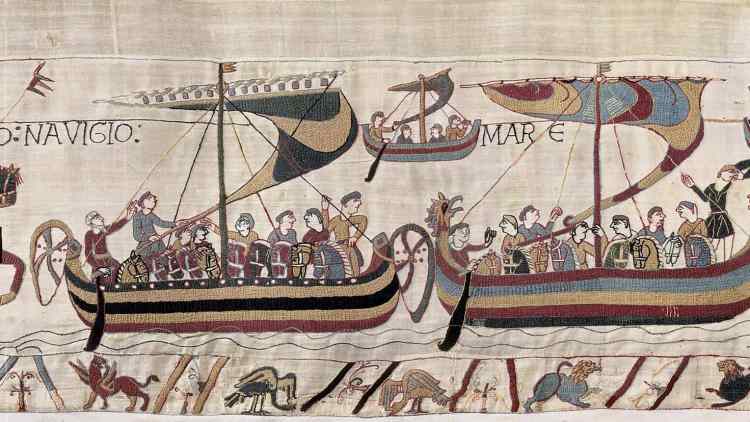
The Bayeux Tapestry is one of the treasures of the medieval world. Across 70 metres of exquisitely embroidered scenes, it tells the story of one of the most seismic events in British history: the Norman Invasion of 1066.
For the last 950 years, this crucial part of our national story has remained on the other side of the Channel in Bayeux in Normandy, but now, for the first time ever, it’s coming back to the UK.
Narrated by Sir Michael Palin, this landmark documentary follows the painstaking efforts to bring this priceless work of art back to the UK – where experts believe it was made – for a once-in-a-millennium exhibition at the British Museum.
We’ll meet the crack Franco-British team involved in getting this irreplaceable object from Bayeux to Bloomsbury without putting a single thread out of place.
Along the way, a stellar cast of historians and experts including Prof David Olusoga, Prof Janina Ramirez and Dan Snow will unravel what it shows us about the events of 1066, unpick the mysteries of its creation and explore what it tells us about the country we’ve become.
Secrets of the Bayeux Tapestry is a Blast Films production (1×60’) for BBC Two and BBC iPlayer. It was commissioned by Suzy Klein for BBC Arts and Jack Bootle for BBC Specialist Factual. The Commissioning Editors are Mark Bell and Emma Hindley. The Executive Producers for Blast Films are Sarah Spencer and Danny Horan, the Director is Joe Myerscough and the Producer is Bernadette Ross.
The Tapestry in numbers
Main section
950 years old
737 animals
627 figures featured
93/94 penises*
68 length in metres
37 ships
33 buildings**
23 trees (and 416 other plants)
9 linen panels used
6 women (3 in the main embroidery, 3 in the borders)
5 types of stitch
4 coloured dyes, creating a multitude of shades
The Tapestry has…
24,204 stitches
16,445 wrinkles
9,646 gaps in the cloth or embroidery
30 non-stabilised tears***
1 cigar hole
Notes
*Academic study by Professor Garnett
**From British Museum’s Bayeux Tapestry section
***2020 condition report on the Tapestry, available on the Bayeux Museum website
Q&A with the contributors
Dr Millie Horton-Insch (Project Curator of The Bayeux Tapestry Exhibition at The British Museum)
“My favourite moment? It has to be the scene with the comet. The entire mood of the Tapestry changes in a moment. It’s sheer cinema.”
Dr Millie Horton-Insch is an art historian and a specialist in early medieval textiles. She completed her PhD at University College London in 2024, on the subject of textiles made during the period of the Norman Conquest. She has published articles on this subject and
is presently the Project Curator of The Bayeux Tapestry Exhibition at The British Museum. Upon completing this project she will take up the position of Lecturer of Dress and Textile Histories at the University of Glasgow.
Have you seen the Bayeux tapestry in person before? What was your first impression?
Before it came to The British Museum, I saw the Tapestry at its museum in Bayeux in 2022. It sounds trite to say that my first impression was that it was bigger than I expected – but that’s honestly the truth! Its scale is extraordinary and a really evocative testament to the monumentality of the events it depicts, that its makers lived through.
Tell us something about the tapestry we might not know.
That scholars estimate that for every hour of embroidery, the thread used would have taken 4-6 hours to make. People always ask me how long the process of embroidery would have taken, but rarely consider how long the linen and thread would have taken to make. The entire object is the most incredible investment of time and labour.
Do you have a favourite scene, or panel?
It has to be the scene with the comet. Immediately after his coronation, the celestial phenomenon is depicted above Harold, who looks stricken. A ghostly naval invasion is depicted beneath him and it’s as though the world is turning off its axis. The entire mood of the Tapestry changes in a moment. It’s sheer cinema.
If you could appear as a character in the tapestry, who would you be and what would you be doing?
Probably Edith. Though within the Tapestry she’s depicted weeping at her husband’s deathbed and three of her brothers are killed at Hastings, we know that after the Conquest she managed to retain some status and land, even commissioning an account of the life of her late husband, King Edward ‘the Confessor’. Not a bad fate for a woman in the eleventh-century!
Q: Why should audiences watch the film?
It was the thrill of a lifetime to watch the Tapestry arrive at The British Museum, quite literally a once in a millennium event. I think that audiences will be amazed to see the work that went into it, it’s wonderful that this documentary will allow them to.
Michael Lewis (Curator of The Bayeux Tapestry Exhibition at The British Museum)
“Maybe I could be one of those men in the Tapestry who witnesses Harold’s coronation – the atmosphere would have been amazing”
Curator: Bayeux Tapestry Exhibition, Dept. Britain, Europe & Prehistory, British Museum; Visiting Professor, Universities of Exeter, Helsinki and Reading; Honorary Secretary, Society for Medieval Archaeology
Michael Lewis is Curator of the British Museum’s Bayeux Tapestry exhibition. Formerly, he managed the Portable Antiquities Scheme (PAS) as Head of Portable Antiquities and Treasure at the BM. Prior to that, he worked as a Curator at the National Maritime Museum (1997-2000) and then for the PAS since 2000, first as a Finds Liaison Officer (in Kent), then its Outreach Officer (2001-3), Deputy Head (2003-15) and Head (2015-25). He is also a Visiting Professor in archaeology and social humanities at the universities of Exeter, Reading and Helsinki, with a particular interest in medieval small finds; he is co-investigator on the AHRC-funded Medieval Ritual Landscape project (2022-6).
Michael is best known for his work on the Bayeux Tapestry. It was the topic of both his MA and PhD theses, the latter exploring the Archaeological Authority of the Bayeux Tapestry (awarded 2004). In 2008, he co-organised an international conference on the Bayeux Tapestry at the British Museum, published as The Bayeux Tapestry: new approaches (2011). Since then, he has written several books, including The Story of the Bayeux Tapestry (Hb 2021, Pd 2024, 2026) with Dave Musgrove, as well as many articles. In 2013, he joined the Bayeux Tapestry scientific committee, which has played a role in advising on the interpretation and display of the Tapestry at the Bayeux Museum (opening in 2027).
Have you seen the Bayeux tapestry in person before? What was your first impression?
Yes, many times over the last 30 years. I have even been inside the case with the BT alone (the BT hung on a rail in its old U-shape case in Bayeux Museum, allowing the BT to be brought inside its case and studied close-up). My first impression, like many people, is its extraordinary length and how well preserved it is for an object over 950 years old. The colours are much more vibrant than many people might expect.
Tell us something about the tapestry we might not know.
Hidden in plain sight is the fact the BT is mounted on a much later backing fabric (this is where the scene numbers were written, probably in the early 1900s. This was removed in 1982 so the back of the BT could be photographed (then put back again), revealing important information about how the BT was stitched, especially sequencing stitches.
Do you have a favourite scene, or panel?
My favourite scene is the death of Edward the Confessor, because it brings together the key characters on the English side, including Earl Harold and Queen Edith. I particularly like the fact that the scene is described in a book that Edith herself commissioned (the Life of King Edward). Here, she says Edward asked Harold to look after her and the kingdom. Maybe it was at this point he decided to take the crown for himself, rather than allow Prince Edgar, the King’s nephew, to rule as it seems was Edward’s wish.
If you could appear as a character in the tapestry, who would you be and what would you be doing?
Maybe I could be one of those men in the Tapestry who witnesses Harold’s coronation. The atmosphere would have been amazing.
Why should audiences watch the film?
One thing people will not learn about in the exhibition is the enormous work and cooperation that took place between the French and UK teams to make this exhibition happen. The film gets across the fantastic work (usually hidden from view) of my colleagues in loans, object handing and conservation etc. I am in awe of them all. It has been a longstanding dream of mine for the Bayeux Tapestry to be in the UK, so I am so grateful to so many people for making that dream come true.
Professor Janina Ramirez (Art Historian)
“No detail is skipped over as being too bloody or gruesome. Horses cartwheel across the battle field, bodies fly out into the margins”
Professor Janina Ramirez is a best-selling author, presenter, lecturer and researcher. She is Director of Studies for History of Art at Harris Manchester College, University of Oxford, and Visiting Professor in Medieval Studies at the University of Lincoln. She has published widely on medieval history, art and literature, has written both fiction and non-fiction for adults and younger readers, and has taught and researched across a broad chronological sweep, covering everything from the sculptures of antiquity to post-modern architecture. She has also written and presented documentaries across the world for over 15 years, including ‘Raiders of the Lost Past,’ ‘The Private Lives of Kings,’ and ‘Art Lovers Guide’. She is Lifelong President of Gloucester History Festival, Fellow of the Royal Historical Society, Royal Society of Arts, Universities of York and Gloucestershire and City Lit.
Have you seen the Bayeux tapestry in person before? What was your first impression?
Yes of course! I have also been a frequent visitor to the copy in Reading Museum, where I’ve spent many days scrutinising specific scenes. My first impression on seeing the original was simply how cinematographic it is! It is long and thin, like a strip of film, and as you move along, the scenes unfold like an action movie. There are tense moments of political negotiations, and we the viewers have the privilege of eavesdropping on these famous figures.
Then the frenetic preparations for the crossing begins, where you can practically hear the clash and bang of tools. When the ships take to the seas the images are so dramatic, with boats crunched together and the waves leaping above the borders. The use of perspective here just makes the sheer scale of the fleet real – what fear the people on the English coast would have felt seeing the mass of ships approaching?!
Then there’s the drama of the Battle of Hastings. This is the climax of the action, and no detail is skipped over as being too bloody or gruesome. Horses cartwheel across the battle field, bodies fly out into the margins, limbs are hacked off, spears and arrows fly. The borders blend with the main part of the narrative and the viewer is simply immersed in this history defining battle. Then it all ends so abruptly with the loss of the final scenes. The whole experience is simply incredibly immersive and dramatic.
Tell us something about the tapestry we might not know.
It shouldn’t be called the Bayeux Tapestry, as it is not a tapestry but rather an embroidery, and it was made in England, most probably by nuns at Barking Abbey. The sheer skills of the women that made it is barely ever discussed. They are working on stretches of linen sometimes 14 metres long, sat shoulder to shoulder, stitching an account of the decimation of their loved ones and their country. They were stitching for their lives, as all around them the political and physical landscape of England was transformed by brutal invaders. It should be known as a ‘mistresspiece’ rather than a ‘masterpiece’, as every stitch we see was made by women!
Do you have a favourite scene, or panel?
There are only three women depicted in the main part of the Bayeux Tapestry, as opposed to over 600 men. My favourite scene is also the most emotionally impactful. It takes places shortly after the Normans have landed on the English coast, and the soldiers have ravaged the local villages in search of resources. A woman runs from a burning house, clasping the hand of a child while two Norman men put flaming torches to the building. It is an important reminder of the human cost of the conquest, and I think was included by the nuns to show viewers that the events of 1066 were not all glory and heroism. The real effects of war are unbearable, and the true victims are often women and children. This little scene is the most human and touching of all.
If you could appear as a character in the tapestry, who would you be and what would you be doing?
I’d have to be one of the guests at Odo’s sumptuous banquet. The food looks absolutely incredible – skewers of meat, rotisserie chicken, bowls full of wine. And the arrangement of the figures around the table was based on a Canterbury manuscript illustration of the Last Supper, so I’d be involved in a simply biblical feast!!
Why should audiences watch the film?
This film really challenges traditional ways of thinking about the Bayeux Tapestry. I was delighted to be able to give an alternative viewpoint which isn’t just about the warrior men and battles, two kings and a duke. It does an excellent job of looking at the Bayeux Tapestry for what it really is – not another textual account of 1066, but rather a staggeringly beautiful artwork, and a unique survivor from the medieval period, which shows us the sights, sounds, smells and sensations of being alive a thousand years ago. Visiting the exhibition is likely to be an overwhelming experience – so much to take in. Watching this film means you can get up close and personal to every little stitch, so seeing it in the British Museum is an opportunity to truly soak up its magnificence!
Rory Stewart OBE (academic, broadcaster and writer)
“I think the film is the best way of really understanding the depth and detail of what can otherwise be quite a perplexing line of images.”
Rory Stewart is the Brady-Johnson Professor of the Practice of Grand Strategy at Yale University – a former UK cabinet minister and diplomat and Member of Parliament for Penrith and the Border. He served in Iraq and Afghanistan, was a professor at Harvard University and has written a number of bestselling books, including The Places in Between and Politics on the Edge. He currently teaches Grand Strategy at Yale University and co-presents the UK’s top podcast, The Rest Is Politics, with Alastair Campbell.
Previously, Rory was the UK Secretary of State for International Development, Minister of State for Justice, Minister of State in Foreign Office and DFID (covering Africa, Middle East, and Asia), Minister for the Environment and Chair of the House of Commons Defence Select Committee.
After a brief period as an infantry officer he joined the UK Diplomatic Service, serving overseas in Jakarta, as British representative to Montenegro in the wake of the Kosovo crisis, and as the coalition Deputy-Governor of two provinces of Southern Iraq following the intervention of 2003. He left the diplomatic service to undertake a two-year walk across Afghanistan, Iran, Pakistan, India and Nepal.
In 2005, he established the Turquoise Mountain Foundation in Kabul, and in 2008, he became the Ryan Professor of Human Rights at the Harvard Kennedy School and Director for the Carr Centre for Human Rights Policy.
Have you seen the Bayeux tapestry in person before? What was your first impression?
My first impression of the tapestry was the almost cartoon-like quality of the panels.
Tell us something about the tapestry we might not know.
Something we often miss are the hidden details, particularly around the frames: leaves, mysterious figures and strange implications.
Do you have a favourite scene, or panel?
My favourite scene is William taking his helmet off. It is the moment when the Norman troops are panicking because they think he is dead, and he lifts his helmet to show himself and inspire them.
If you could appear as a character in the tapestry, who would you be and what would you be doing?
If I appeared as a character in the tapestry, I would be King Harold with a hawk on my arm, riding through Normandy.
Why should audiences watch the film?
I think the film is the best way of really understanding the depth and detail of what can otherwise be quite a perplexing line of images.
Professor Tom Licence
“Who would I be? A small figure in the lower border at the end, tending the wounded and the dying.”
Tom Licence is Professor of Medieval History and Literature at the University of East Anglia and a Fellow of Magdalene College, Cambridge. He’s a specialist on 1066, whose work has made the front page of the New York Times and the Today Programme. A regular guest on podcasts and writer for newspapers and history magazines, he’s the author of biographies of Edward the Confessor and Harold.
He lives in Norwich with his family. They relax in the Norfolk Broads with friends and visiting the seaside.
Have you seen the Bayeux tapestry in person before? What was your first impression?
I saw it in Bayeux many years ago. I remember thinking it was like a very long cartoon and thinner than I imagined it would be.
Tell us something about the tapestry we might not know.
In 1792, local authorities agreed to it being made into a covering for military wagons. It was rescued in the nick of time.
Do you have a favourite scene, or panel?
Harold’s coronation – as I interpret the scene – where King Harold and Archbishop Stigand look straight at the viewer. This is bold. Figures on the Tapestry don’t look at the viewer. I wonder what’s going on.
If you could appear as a character in the tapestry, who would you be and what would you be doing?
A small figure in the lower border at the end, tending the wounded and the dying.
Why should audiences watch the film?
To hear from the people who are passionate about the Tapestry – whose life’s work is to study it and 1066. You’ll get all the behind-the-scenes knowledge and expert insights.
The Animators
PeepShow are the creatives behind the wonderful animations in the documentary. Their challenge was to come up with animations that could sit alongside the real tapestry without overpowering it, or ending up in Monty Pythonesque territory, as pastiche.
“It was a huge amount of work to produce in such a short timeframe. Especially in such a labour intensive style. But it was a lot of fun to produce. The Battle itself was probably the most amount of work, requiring so many different shots to create the intensity of a medieval battle. However the smaller, quieter scenes – such as Edward the Confessor’s Death – are almost more challenging to produce as there’s no flashy movement to fall back on. Therefore you have to rely on some not-so-subtle metaphors such as candles being snuffed out instead.”
Inspiration
“The inspiration for the animations came from a desire not to animate the tapestry. The logical route would have been to breathe life into the characters that already exist in the Bayeux Tapestry. But that is quite limited in animation terms as everyone can only move side to side. Also, we imagined at the pitch stage, that there would be a lot of shots of the tapestry itself and therefore it made sense to go in an entirely different direction. Charcoal and pastels felt like the right choice for something which needed to be atmospheric and historically murky.”
Pete Mellor is an Emmy Award-winning animation director and a key member of the London-based design and illustration collective Peepshow.