
Your Droids – They’ll Have to Wait Outside
July 26, 1997
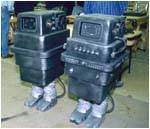 Apparently droids require passports to enter Tunisia. A Special Effects team member was traveling with R2-D2, and ran into some trouble at customs when he tried to get the little droid off the plane. Tunisian officials demanded that R2 get his photo taken and be placed in a special section in the crew member’s passport. Only then was R2 allowed to legally work in Tunisia. Hoping to avoid further difficulties on location, Lucasfilm is considering issuing British passports, American green cards and European work visas to all droids and creatures. Just to be safe, there is also talk of registering Jabba the Hutt with Interpol.
Storm hits Star Wars Production in Tunisia
August 11, 1997
The crew was enjoying a spectacular dinner-time display of heat lightning over their hotel in Tozeur, Tunisia, at the edge of the North African Sahara. The desert sky would briefly explode with a brilliant bluish-white light and then go dark again as if nothing had happened. After a few minutes, the wind started picking up, and the dining hall quickly filled as people came in to take shelter. Actors and crew joined excited children at the windows to get a better look at the wild show.
Then the windows started to blow in and the rain began pouring down.
The production staff ran to their offices and quickly set up a command center, trying to get in touch with anyone who might still be on the set. The directorial staff convened an emergency meeting to devise contingency plans, as well as the next day’s plan of attack. Every other department, from set decoration to props to creatures to costumes to make-up, worked quickly to assess what they could cobble together should the set be blown away and have to be rebuilt from the ground up.
Early the next morning, long before dawn, a four-wheel-drive vehicle was sent out to see if the roads to the site still existed and to assess the damage to the set. After an hour of tense waiting, a radio signal was sent back to base, where producer Rick McCallum instructed the crew to come to the set to help rebuild. The crew, traveling the rough roads in a convoy, set out into the dark, not knowing what lay ahead of them.
As the long train of headlights ventured out into the desert and illuminated the landscape, it quickly became clear that the situation was serious. The desert was actually wet. Crew members steeled themselves for the worst as they arrived at the filming site.
The Tatooine set had the feel of a post-tornado trailer park. Hundreds of costumes had been scattered across the desert floor, caked in wet sand. Dressing room tents were torn to shreds. Metal scaffolding was twisted into impossible shapes. Equipment trucks had been punctured and slashed by windblown shrapnel and debris. Droids lay all about, broken and battered like corpses on a battlefield. Plaster buildings on the set had crumbled to pieces, and the landspeeders had been bodily lifted and thrown into one another. Simply put, the set had been devastated.
Director George Lucas immediately took the Main Unit and began piecing together a shot in a relatively undamaged area. Roger Christian and the Second Unit did the same. In the meantime, Rick McCallum met with department heads to assess the damage and to coordinate the rebuilding.
Drills, saws, lumber, electrical cable, and plaster appeared as if out of nowhere. The sound of hammering filled the air, along with orders shouted in English, French, and Arabic. Wooden frames started to pop up almost instantly. Costumes and creatures were dug out of the sand, cleaned off, touched up and left to dry on whatever structures were still standing. New generators were brought in to replace the ones that had blown up. Cranes were brought in to lift fallen structures and repair damaged vehicles. Jeeps were speeding back and forth across the desert, bringing water and supplies where needed. Cameramen were helping out with wardrobe, special effects guys were lending a hand with make-up, and caterers were assisting with construction. In the end the recovery was extraordinary, and the production miraculously managed to remain on schedule.
Through it all, George and Rick managed to stay in good spirits. Rick told tales of earthquakes and floods on the set of Young Indy, while George calmly pointed out that the same thing had happened over twenty years ago on the set of the original Star Wars, and that perhaps the fact that it happened again was a good sign.
Coruscant Development
September 1997
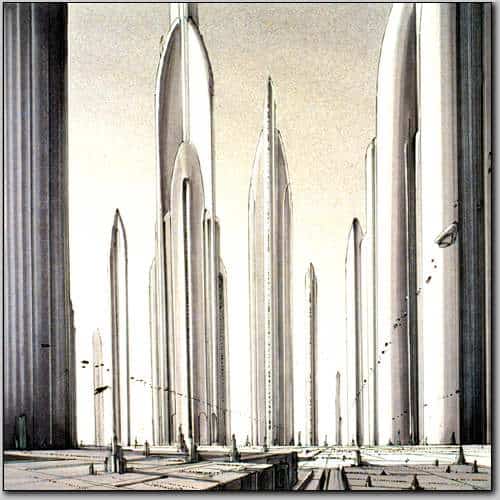
“The first picture is one of the early overall views of Coruscant. Stylistically, George wanted something that was very sleek, because he wanted Coruscant to be a city of mixtures — a combination of really sleek architecture with some older-style architecture. This part of town was the newer, sort of Art Deco or Art Moderne-type area. That’s why we have these really sleek, modern forms.
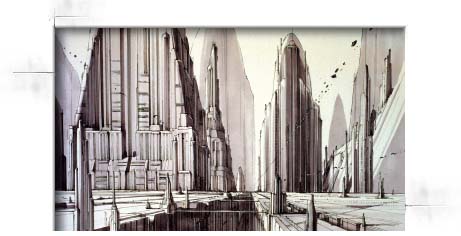
“The other idea that George wanted to pursue is developed in the second picture, which is the older version, going more towards some of Ralph McQuarrie’s original concept designs. Here, we see more pyramidal shapes, more concrete and older materials.

“George liked both of these directions, so what he wanted to do was combine both stylistic elements into one image, and that’s what you see in the third picture. It was like taking Manhattan and scaling it way, way up. All of these buildings are mile- and two-mile-high skyscrapers. We never really see the floor, because this is a city of such large buildings. Each one of them is several blocks wide at the base. This was the overall view, with flying traffic going throughout the city — a very 3D world.
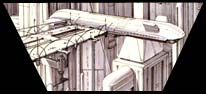 “From here I developed another sketch which is taking the same idea but getting a little more personal. We see a public transportation station, where we have these large, ocean-liner-sized busses docked at a Grand Central Station-type building, and we see people getting on board.
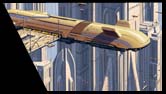 “These were the views we were going to see for Coruscant. For the painting, I combined these elements because they show most of the epic scale, along with the more human scale, where we see people getting into vehicles. That was the basis for the painting.
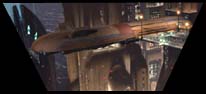 “While these scenes were designed as part of the Episode development, we decided to use the imagery as a small preview in the Return of the Jedi Special Edition. When George began work on Jedi, he wanted to enhance the celebration at the end of the movie. He wanted to have us visit Coruscant, and give a taste for the look of Episode I. It also allowed us to use the celebration as a testbed for how these shots would play out, how they would look on the big screen. As a result, we used the end of the last movie as sort of a preview for the first movie.”
The Many Faces of Episode I
September 19, 1997
As Episode I comes together, we are witnessing an experimental new style of filmmaking in action. Director George Lucas’ approach to the creation of Star Wars: Episode I has made the creative aspects of this production significantly more free-form than large-scale productions are accustomed to. Lucas has always emphasized the power of the editing room to shape a film, but in the case of Episode I that power will be especially strong.
Many scenes for Episode I begin to take shape with a rough video cut of the action and pacing – “animatics,” or scene sketches created from footage such as rough models, computer elements, and actor stand-ins (often personnel handy in the hallways at ILM or Skywalker Ranch, sometimes holding broomstick lightsabers). This rough cut can be modified like a pencil concept sketch, quickly and easily on Avid non-linear editing equipment, where shots can be cut, pasted, and rearranged just like words on a computer screen.
The animatics provide a flexible blueprint for filming. Footage shot each day here on the soundstages of Leavesden Studio can be cut into the animatics, allowing Lucas to consider how well the shots work in the context of a scene’s flow. This will lead to additional shooting and writing of scenes.
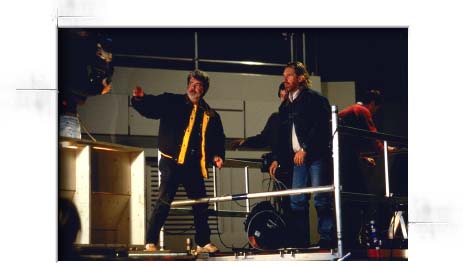
Lucas intends to carry creative flexibility to an unusual degree with Episode I. The shooting schedule includes plans to re-assemble the production crew in 1998 for shoots of additional elements and possibly the shooting of entire scenes if the evolving story suggests new directions. Everything from character names to plot points remain subject to later change. “So much of what this movie is remains only in George’s head at this time,” commented a co-worker on the set, “and as he has told us, that may really become something different before the film takes its final form.”
This will hardly be the first time that Lucas has kept his creative options open. Luke Skywalker was originally written as a girl, and was later named Luke Starkiller all the way up until the first day of shooting for the original Star Wars. Key plot elements of The Empire Strikes Back and Return of the Jedi changed drastically in the editing room when “actual” dialogue was dubbed over the “prop” dialogue spoken by some actors from the shooting scripts.
Whether the same sorts of security measures are being taken with Episode I our director (not surprisingly) refuses to confirm, though we can admit that “there are rumors” of misleading scenes being filmed for the preservation of mystery, as well as multiple versions of the shooting script with alternative names and scenes. Of ‘leaks,’ Lucas will only say “don’t count on it until you see the movie.”

|






Comments are closed.