
In a dark, cavernous underground sound stage, two women crouch, their eyes riveted to a giant movie screen. Projected in front of them, frame by frame, is the final cut of Star Wars: Episode I. Like musicians in an orchestra pit playing to a celluloid score, they take their cues from the movements of the images flickering in front of them. The duo of performers creates a sound to match the movement onscreen wielding mysterious metallic instruments. Highly sensitive microphones record the specialized work of these two women. Lithe and highly focused, Dennie Thorpe and Jana Vance are the foley artists of Lucasfilm. Together with their partners, Foley Recordist Frank “Pepe” Merel and Foley Mixer Tony Eckert, they provide the ambient sound effects of Episode I.
 These subtle yet essential foley effects – the footsteps, the cape movements, the rattle and hum of everyday life – provide all of the natural sounds that exist between the remaining layers of sound in a film. Many films utilize a foley track because sound as recorded on the set is often unusable. Background noise like a plane flying overhead or the toot of an automobile horn can obscure dialogue. Sometimes live sound recorded on a set must be replaced because sets created to look like real environments are actually fake. For example, when Ewan McGregor (Obi-Wan Kenobi) and Liam Neeson (Qui-Gon Jinn) faced Ray Park (Darth Maul) in Episode I’s climactic lightsaber battle, they were actually performing on a set constructed of plywood made to look like metal. The live sounds recorded during this scene consisted of a series of heavy footsteps on plywood, the clack of prop lightsabers and the breathing of the actors as they performed the complicated fight choreographed by Stunt Coordinator Nick Gillard. To create the necessary illusion of realistic sound, Dennie and Jana recreated the scene foley-style by running, jumping and occasionally falling on a special square of marble “spaceship” surface. The other sounds, like the lightsabers and doors opening and closing, were created by Ben Burtt and his sound editing team. 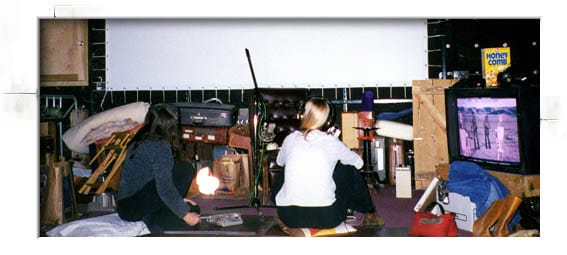
The Episode I foley team has worked together for over three years, though Dennie has been part of the Lucasfilm foley team since she walked in both Darth Vader’s and Luke Skywalker’s footsteps in Return of the Jedi. “It was my third or fourth job and I was scared to death,” says Dennie, “because I was doing it by myself. Yet it was fun.”
 The well-knit team works closely with Sound Designer Ben Burtt. At the beginning of Episode I production, the foley team and Burtt watched an early cut of the entire film. They made a scene-by-scene analysis to determine which foley effects were needed. After foley work for each 10-minute reel was completed, Burtt returned to the foley stage to evaluate a playback. The group then discussed the sounds and determined what needed to be altered, enhanced or simply redone. Each day the busy team created approximately 200 different “sound events,” which are unedited recordings that will eventually be crafted into finished sound effects.
Their huge sound stage is full of real-life objects – ancient vacuum cleaner canisters, the battered hood of a car, a mini-swimming pool, and cabinets of stuff that most would be hard put to identify. “Very low tech stuff sounds great when used in creative ways,” says Jana. Yet, though the foley cupboards were packed, the team decided that they would need a set of truly unusual sounds for the production of Episode I. “Often,” says Tony Eckert, “the real movement doesn’t sound as real as you’d want it to and the artist must find a more suitable object with which to create.
 This search for unique sounds led Dennie and Jana on a foley shopping spree to several scrap yards in the Bay Area with a special mission to find the perfect droid parts. While imagining the movement of the battle droids, Dennie had a brainstorm. “I was a foley artist for the T-1000 on Terminator 2,” says Dennie. To capture the chilling metallic footsteps of the T-1000 she had had a pair of perfectly ordinary boots resoled with metal plates. Planning the droid movement in Episode I, she continues, “it occurred to me that those monstrous boots I used in T2 would work perfectly.” Soon afterward Dennie and Jana were each fitted with a pair of specially made boots – Dennie’s combat boots were soled in brass while Jana’s cowboy boots sported thick steel soles. They were then able to create a sound unique to the battle droids: a heavy and metallic footstep, with a bit of a slide. “The droid sounds in the final battle scene took meticulous prep time,” says Jana, “and although each sequence only lasts 2 minutes on-screen, it probably took us about half a day to create it.”

Once Dennie and Jana have walked a character for one reel of film, they can anticipate a character’s every movement. At this point they don’t need to look at every cue. “It’s because we have them ‘muscle memoried’,” explains Dennie. Dennie performed the parts of Obi-Wan Kenobi, Anakin Skywalker and Padme Naberrie. Jana “walked” the parts of Qui-Gon Jinn, Jar Jar Binks and Darth Maul. Of Ray Park who played Darth Maul, she says, “he was incredible – he was more like a dancer than an actor.”
 Although Dennie and Jana performed their characters individually, there were some effects they created as a team: the big battle scenes, and the movements of the larger creatures. Together they did the saddles and bridles of the kaadu, a giant beast used by the Gungans, and modeled these sounds on everyday equestrian equipment. “We’d been doing horses for years,” says Tony, who had assumed that the job would be a straightforward one. But what made the kaadus unique is that they’re enormous in size and completely computer-generated. The team began their approach as they would for a horse, using leather straps and clinking metal parts. Then Tony laid special microphones to pick up the deepest frequencies, enlarging Dennie and Jana’s human movements so that they would sound massive.
 On Episode I, almost every reel the foley team worked on had 24 tracks of different sounds. Foley Editors Bruce Lacey and Marian Wilde would determine the foley effects to be recorded each day, creating a cue sheet that looked like a musical score – with movements set to time. This cue sheet was then passed to the Episode I foley team who would read, for example, that at the thousand feet marker of a particular cue sheet, a battle droid would walk on a marble surface for ten feet. Because of this system, the team was able to perform and record each scene in a very efficient manner.
 After the foley sounds were recorded, they were handed to the editors who examined each movement on every track to determine whether the foley work had been done in synch with the picture. Then the editors used a computer to cut and nudge each sound into place. Once this initial composition was complete, it was passed on to a pre-mixer who mixed the bulky 24 tracks of foley down to either 3 or 6 tracks. At this point the Episode I audio existed as groups of pre-mixes – a music pre-mix, a foley pre-mix, an effects pre-mix and a dialogue pre-mix – which were combined during a final mixing session overseen by George Lucas.
The foley track can cue the audience to pay attention to certain characters or actions. Just as music can sway your emotion, foley influences where you focus your attention. When done well, foley enhances individual characterizations. Some in the business consider foley to be the glue that holds a picture together. “It’s just like life,” explains Tony. “If you sit with your eyes closed and start to listen you’ll hear the scuffing of cloth, or someone dropping a glass. You don’t really think about it – you just accept it. But you’d miss it if it wasn’t there.”

|




Comments are closed.