

Chris Neil’s work as dialogue coach on Revenge of the Sith comes through with a mix of performance insight and on‑set adaptability, showing how he helped actors navigate the emotional demands of pivotal scenes. The feature highlights how Neil guided cast members through rhythm, intention, and clarity, shaping moments where subtle shifts in delivery carried significant dramatic weight. His coaching added a layer of refinement to performances that needed to balance operatic intensity with grounded character truth, especially in a film filled with turning points. It also reflects on the collaborative environment surrounding his role, where Neil worked closely with directors, actors, and department leads to ensure each scene’s emotional tone aligned with the film’s broader arc. The piece captures how his instincts and communication style supported the cast through complex dialogue and heightened stakes, making his contributions an essential part of Episode III’s performance landscape. His work stands as a reminder of how behind‑the‑scenes guidance can elevate the final impact of iconic moments.
Archived here with Permission utilising The Internet Archive Wayback Machine. A premium curated compilation of historical galactic data manifests.
|
Chris Neil: |
|---|

Delving into the Power of Myth
Working as a dialogue coach on such films as The Virgin Suicides, The Rainmaker and Jack, Neil has a special talent for getting actors to give their best performances in the most challenging of roles. In fact, he left such a lasting impression on the Coppola family with his work on both The Rainmaker and The Virgin Suicides that he was referred to filmmaker George Lucas as the perfect candidate for the dialogue coach position on the crew for Revenge of the Sith.
At the suggestion of Coppola, Neil met with Lucas and McCallum to discuss his potential role as a dialogue coach for Episode III — a film that would demand some of the most challenging and emotional scenes from its cast yet.
Neil wasn’t exactly a stranger to Lucas either. Neil’s father and Lucas worked closely together on Coppola’s 1969 film The Rain People.
To prepare for what would be some of the most dramatic performances in the Star Wars saga, Neil read the work that first inspired Lucas to tell the Skywalker family tale — Joseph Campbell’s The Power of Myth.
Using a Workshop Environment
“When George shows the visual script to the cast, it’s to give them a physical description of the landscape, the characters and so on,” Neil explains. “But the actors also need an emotional script to help with their reactions between each other during a scene. Anakin’s been gone for this long, what kind of emotions has that brought up for Padmé? How has she dealt with the pregnancy? Is there resentment in the relationship? What kind? How have the characters dealt with separation in the past? How does Anakin feel about the secret now?”
“George said something really interesting when we were at the beginning of shooting,” Neil recalls. “He said, ‘In every shot that you see in a film, there are 100 decisions that have been made. Whether it’s production design or costume or photography or lighting, and it only takes one bad decision to ruin ten good decisions.’ That’s true when it comes to handling an actor’s performance. You can have an actor who is doing an amazing job, but then you can have an actor who has made a wrong choice, and suddenly it throws everything off in the scene. In dealing with the second tier players, and the actors who were just coming in for a day or two who didn’t have the chance to read the script, it was my role was to help them make the right choice so that when they came in to work with the first tier players, it was working in sync. I had to make sure that their presence wasn’t throwing things out of whack.”
“When we had big scenes with a lot of day players like the Senators for example, one of my key functions was to take them aside and work on the scene to help them figure out, in a brief way, what the back stories of the characters were,” Neil says. Neil found that the workshop environment also helped the more seasoned actors throughout filming. Every Saturday, without the hustle and bustle of the crew, members of the cast, Neil and Lucas would meet on the otherwise empty sets for regular rehearsals.
“I wanted to help the actors find natural reactions to what they were saying,” Neil says. “During the rehearsal sessions with Natalie and Hayden I would help steer them into that place. They’re both very naturalistic actors, but it was helping them make the scenes more personal. I wanted them to grasp the history of the relationship between the two characters and reveal the intimacy of two young people in love with subtler details. Sometimes actors think about the films in a grander scheme, and it’s really more productive to look at it from a scene-to-scene approach so that you can just really focus on how the characters react to one another. For example, what if when Padmé walks into the room, she puts her hand on Anakin’s shoulder? That may not be written in the script, but it suggests a loving moment. It’s those little things that help create a history between the characters, which in turn them more believable.” Impressive Performances
“Hayden’s an incredibly soulful, deep-reaching actor,” Neil says. “It’s not easy to find the right times to be deep or to just play a young, hot-shot pilot. Hayden has the tendency to go really deep, and which is a great thing for an actor. Even more so than Episode II, Hayden knows he’s dealing with an outcome to a character that everybody’s expecting. So he has to deal with that pressure from the actor’s perspective just as George is wrestling with it from the writer and director’s perspective. How do you tell a story that everybody knows the ending to? And how do you be true to the character? And most importantly, how do you use your best skills as an actor to make the character believable? The last half of the film Hayden is a darker, more-consumed character. As an actor he’s made physical choices that have really accented the scary aspects of the character, which is a testament to his acting skills. There’s a soft side to Anakin in the beginning of the story. He’s really just a young guy in love. But by the end of the tale, he’s very different. It’s been great to see Hayden play that so well.” In addition to working with the younger actors, Neil found the performance of stage and film veteran Ian McDiarmid inspiring.
“One of the remarkable things for me during this production has been working with a master filmmaker who had such an effect on cinema and has created such archetypal works,” Neil confesses. “Yet he’s still willing to take in this kid and ask him, ‘Okay, tell me what you think I should do with
|
 Professional athletes aren’t the only ones who benefit from the advice and extra inspiration from a dedicated coach to help them reach their best potential. Episode III Dialogue Coach Chris Neil offered everyone from seasoned actors like Hayden Christensen and Natalie Portman to unknown extras the one-on-one attention they needed to push them beyond their own expectations.
 “Completely out of the blue Francis Ford Coppola contacted me to say, ‘Rick McCallum is going to be calling you to offer you the role of Dialogue Coach on this next episode of Star Wars,'” Neil remembers. “I was working on another film at the time, so I waited for my cell phone to ring. And sure enough, 20 minutes later Rick called and asked me to be on a plane the next morning.”
 “George and Rick both knew that there needed to be a certain amount of attentiveness paid to the actors on the movie,” Neil explains. “There was not anybody in my position there for the previous two films and I think there was a discussion about that void that needed to be filled. Fortunately, Francis advocated that I go on the film because I had served roughly the same function on his last two movies. He and George obviously have a really close relationship so I think the fact that Francis could say on a real personal level to George, ‘This kid is not going to intrude upon you, he’s there to be of service to you and to the actors,’ was a reassuring thing.”
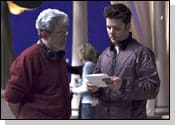 “They share great memories of their formative years in film and I think that that’s an added texture to our relationship for sure,” Neil admits. “I’ve pretty much seen George yearly ever since I was a little kid. It was always like, ‘Hey, how’s it going, George?’ at a softball game or a picnic or something like that. That familiarity adds to the level of comfort working with him on a film. I don’t feel like such an outsider with him.”
 When Neil was offered the Dialogue Coach position, he realized that his usual experience working on dialog-heavy films such as the critically-acclaimed The Rainmaker or the indie hit The Virgin Suicides would be drastically different when compared to the Star Wars saga which often pitted actors against characters created digitally by Industrial Light & Magic in post-production.
 “Aside from working with Francis on two films, I’ve basically specialized in working with first-time directors who are making the transition from commercial work into their first feature,” Neil explains. “One of the directors I worked with once called me his ‘Extra Lobe,’ meaning that I was the part of his brain that was focused on paying attention to the performances from the actors so he could pay closer attention to other details. I think I also serve as a support person for the director and the actors because there are so often so many other distracting things, especially when a director is so inundated with questions that sometimes the subtleties or the attention that needs to be paid to the acting is not there.”
 “Whether I’m working closely with the director in an acting coach capacity, or as a dialogue coach, I do the same preparation because I have to do it for myself in order to get a better understanding of the story,” Neil says. “When I am working with the actors or giving the director notes for the actors, it all comes from the same place. I need not just a deep understanding of what the director is trying to get at, but also what the fundamental roots of the story are. I go back to the source — to the mythical qualities of the story. Those tend to always answer the deeper questions about what a character’s motivation is. It’s the bigger picture stuff that always answers the smaller questions.
 I read all of Joseph Campbell’s work that I could get my hands on,” Neil continues. “It reminded me of the story behind Padmé and Anakin’s relationship; especially the pivotal journey for both of those characters. It’s the homework I do as a dialogue or acting coach. And sometimes it doesn’t even enter into my equation in talking to George. But if I’m working on a scene with Natalie and Hayden, that information just seeps through unconsciously. It answers the questions when we’re having a conversation about something, and that information clarifies things.”
 While Lucas revealed the physical aspects of environments and the appearance of the characters to the actors with his visual script, Neil found it helpful to the actors to also flesh out an emotional script to showcase the inner motivation of Padmé, Anakin and Obi-Wan.
 Neil’s deeper understanding of the script’s bigger story and inner conflicts between the characters helped him to better gauge the performances of not only the main actors such as Christensen and Portman, but he also able to see what extra attention needed to be focused on the supporting actors and extras in various scenes.
 Due to the highly confidential nature of the set, many secondary actors on the set did not have access to the script until the day they were to shoot a scene. Neil decided to create a workshop environment for the second tier players to help them better prepare for their scenes.
 “Then when they came to the set they had a better level of understanding and we weren’t trying to play catch up when we were shooting.”
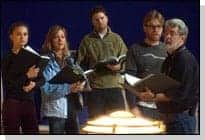 “I think it’s been useful for George in a practical sense in that he gets to see how the actors move around the set for the first time,” Neil says. “It also allows the actors to work on a tough scene in a collaborative way without the distractions of going through the process of costume and makeup. To have the director and the actors be there relatively alone on the stage is a great freedom. The actors can also speak up about what does and doesn’t work for them in their performances. However, during rehearsals there wasn’t much tweaking of the script or the sets. George doesn’t vary much from what he was doing on Saturday rehearsals in terms of moving the actors around on the set. He saw what he needed to see during rehearsals, and then he did his homework in his head when he came to the film the next Monday.”
 It was during these rehearsals that Neil worked with the actors to dig deep for emotions in their characters they may never have explored before.
 While Neil guided the actors to trust their instincts to reveal subtle nuances, he discovered that some of the actors such as Christensen, Portman and Ewan McGregor — who have in some respects grown up during the filming of the prequels — used their real life friendships to reflect the closeness towards each other on the big screen as well.
 As one of the most anticipated performances of Episode III, Neil also paid special attention to Christensen’s approach to the transformation of Anakin to Darth Vader.
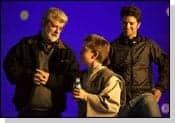 “Coming from that English stage background where actors learn the lines from a more traditional method, Ian nails it every single time,” Neil says. “Ian knows the character. And the choices that he does make as an actor are so subtle that you don’t get it at first. But then when you sit back and you watch it, the performance has a much more subtle, yet more profound effect. I think that’s one of the interesting things when you compare Ian to the rest of the cast. In all the Star Wars movies, you had this great medley of different acting styles — naturalistic, off-the-cuff spontaneous approaches to characters. And then you have a very composed British stage quality to Ian’s character of the Emperor.”
 While Neil conducted workshops and rehearsals for the actors to better hone their skills, he found Lucas also open for suggestions.
 the actors.’ He’s so open to me saying, ‘Why don’t you try it this way?’ Or open to me reminding him of maybe it’s logical for the actor to do something different than they’re doing now. I think it’s definitely a sign of sophistication and self-confidence as a director that he’s not closed off to having that kind of input. He knows what he wants and is incredibly decisive. But if I point something out to him, he’ll make necessary adjustments. I have a great respect for someone who understands the value of having people help him in areas that are most beneficial to him.”

This Sith fragment was recovered from the ancient ruins of Moraband…(Naaaah, YOU know where)
Please Share this post:
- Share on X (Opens in new window) X
- Share on Tumblr (Opens in new window) Tumblr
- Share on Mastodon (Opens in new window) Mastodon
- Share on Bluesky (Opens in new window) Bluesky
- Share on Facebook (Opens in new window) Facebook
- Print (Opens in new window) Print
- More
- Email a link to a friend (Opens in new window) Email
- Share on Threads (Opens in new window) Threads
- Share on Reddit (Opens in new window) Reddit
- Share on Pinterest (Opens in new window) Pinterest
- Share on LinkedIn (Opens in new window) LinkedIn
- Share on WhatsApp (Opens in new window) WhatsApp
- Share on Nextdoor (Opens in new window) Nextdoor
- Share on Telegram (Opens in new window) Telegram