
Nick Gillard on Jedi Swordplay
May 21, 1998
“I hate stunts that look like stunts,” says Episode I Stunt Coordinator Nick Gillard. Gillard strives for a no-nonsense, realistic look to the work he supervises, and Episode I will feature Gillard’s elaborate Jedi swordplay choreography. The real-life Jedi Master has drawn upon his extensive knowledge of martial arts to create the moves of the Jedi, and has created fights which are more than just exciting to watch.
“Every parry is deliberate,” Gillard says. “There is no pure cinema stuff, no meaningless flourishes. There are no moves that would actually leave the fighter open. In some cases the fights are going so fast that you can hardly see all this, but if you slow it down, you can see that every move is for real. Both Ewan and Liam got into this so deeply that they became literally as fast as our stunt guys. They were incredible.”
 Gillard was very concerned to avoid what he sees as common pitfalls in cinema swordplay. “In films the fighters always know where the next blow is coming from, and they often end up giving that away, anticipating the moves of their opponent,” he says. Gillard worked intensely at avoiding any trace of telegraphing in his Jedi fights. “Every strike is at a target. And we all took a few knocks working it all out. There are no punches pulled in these fights.” Presumably, this explains the stunt team’s tendency to wreck a large number of lightsaber props during the course of filming.
For all the work that has gone into making these fights as complex as a chess game between masters, Gillard is most pleased about the way in which the lightsaber battles support the story. “It’s all subtle, and I suppose no one will ever notice this sort of thing, but every fight has a story structure in it. Each confrontation is about the warriors learning what they are up against, learning about their opponents. And the moves of each character grow specifically from that character’s nature, their position in relation to the light and dark sides of the force.”
Battling against telegraphing anything, Gillard wrote the fights as real confrontations of near-equals. “This was meant to be like matching Porsche Turbos against each other,” he says with a grin. “And no fight was written with an inevitable conclusion,” he notes. “This makes an outcome all the more unexpected when it happens. Even for us watching the action on the stage.”
“In this situation, it would be so easy to go overboard,” Gillard reflects. “But this work shouts to be controlled, subtle. The Jedi are doing the moves they have to in order to survive. The realism in the fights tones the fighters down to a human level. Their moves are limited; they have Jedi powers but they are not super heroes with magic abilities. They are more like you. They could lose. And that makes you feel more for them, I hope.”
 Trading Lightsaber Blows with Obi-Wan Kenobi
December 16, 1998

Stunts have always had their place in movies, and actors have always had their part to play in making the stunts work for the camera. However, as Ewan McGregor discovered during the shooting of Star Wars: Episode I, lightsaber fighting is quite different from anything else.
McGregor thoroughly enjoyed learning to master the elaborate Jedi fighting style created by Stunt Coordinator Nick Gillard, who combined the techniques of Epee, Kendo, and Rapier, throwing in a little influence from tennis and tree chopping for good measure.
The result is a truly unique martial art: lightsaber fighting. Practicing was a pleasure to McGregor, and he quickly became comfortable fighting his way through the choreographies carefully penned by Gillard. “It’s been quite hard work, but I enjoyed it,” McGregor says. “Once you’ve got it set, it feels really good when you go through a whole fight without having to worry what’s next.” Rarely stepping down for a stunt double to take his place, McGregor faced the scorching blade of the lightsaber himself. “I did as much of the fighting as I could. I mean, I can’t backspin over somebody’s head, so someone else did that. But most of the fighting I did. A lot of it.”
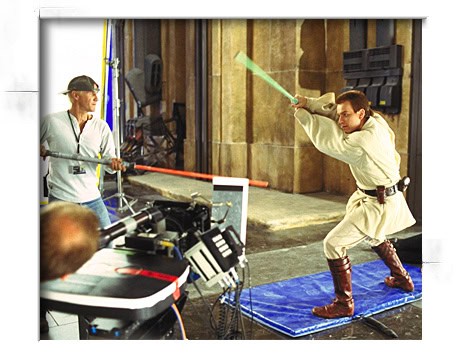
A lightsaber fight on the set is very different from that same fight on the theatre screen. The high number of digital effects and bluescreen backgrounds prevent the confrontations from being as compelling during shooting as they will ultimately be when computer work is completed, and the real-life fights are left a lot more abstract. Waving a lightsaber at invisible threats – to be digitally inserted later – feels a lot like fighting against air, and it’s a skill all its own. “It’s got a lot to do with the pace, because it’s easy to slow down when you’re facing a blue screen,” says McGregor. Indeed, things need to keep moving, even if they’re not there yet. To this end, Nick Gillard’s instructions and advice were of paramount importance.
 “There’s Liam and me, and we need to deflect all the laser bolts that are flying towards us, and I was just being too vague with it,” McGregor recalls, the problem being, of course, that there were no laser bolts to be seen on the set. “Nick kept telling me how important it was to be very sharp and very quick because they would be coming from all over the place, and also that I needed to look at where they were coming from. I waved my lightsaber around, but Nick said my movements needed to follow my eyes, because you have to see the laser bolts before you can block them. So it’s a lot about your eyes, and your making everything look sharp and precise. We worked it all out, and it turned out to be just great.”
There is one thing, however, that McGregor did regret at the end of a day’s fighting: “I wanted a lightsaber that works!,” he says, laughing. Judging from the bruises the brave actors sometimes brought back to their quarters at night – not to mention the impressive number of lightsaber props that were wrecked during shooting – it’s probably a good thing McGregor didn’t get his wish. Otherwise, Obi-Wan might have faced his destiny a few decades early.

|




Comments are closed.