
Schadenfreude & The Joy of Shared Disappointment

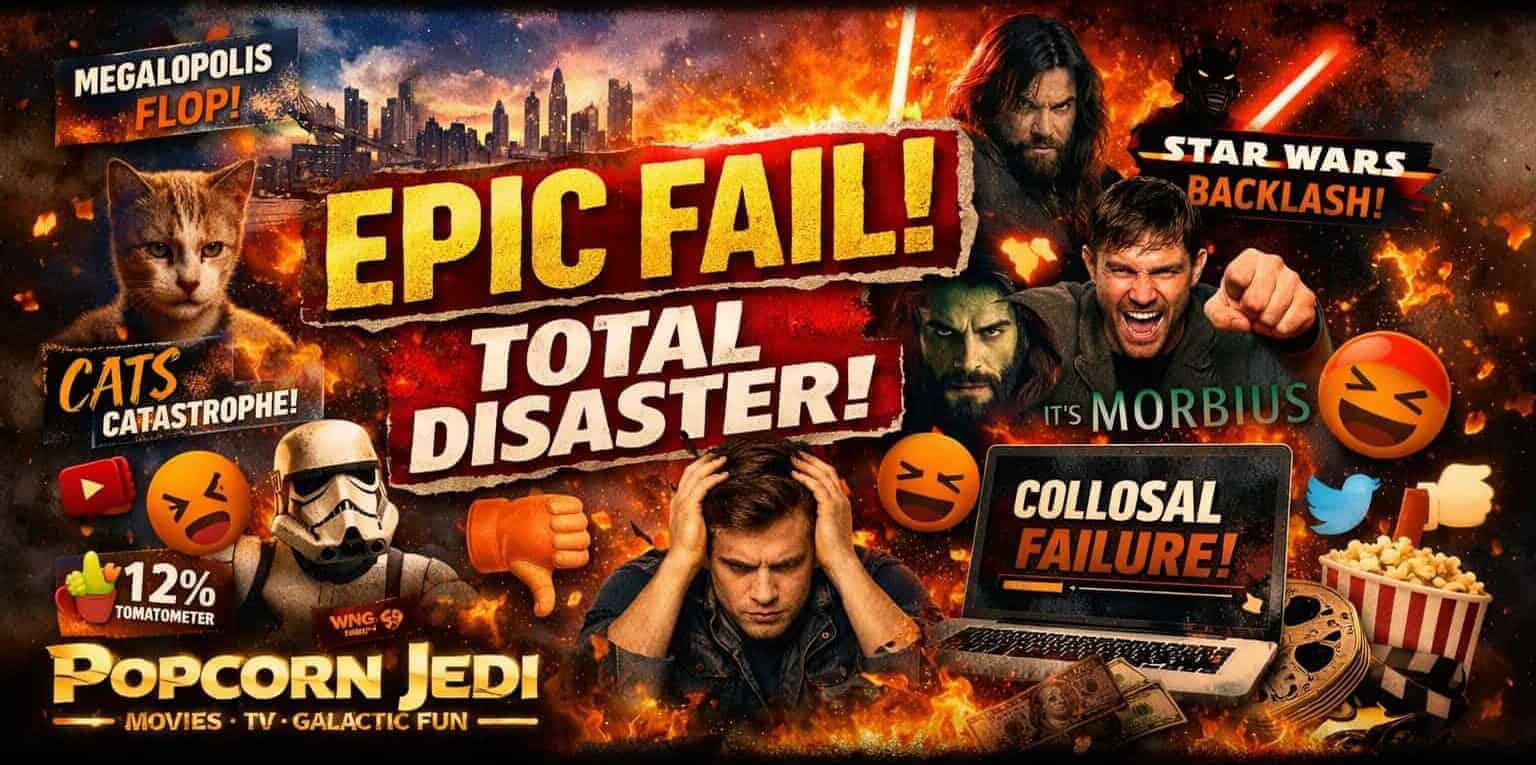
There’s a strange, undeniable truth about modern fandom: people love watching movies and TV shows fail. Not just “mildly underperform,” but spectacularly implode, crash‑land, face‑plant, and detonate across social media like a cinematic firework display.
It’s not new — but the internet has turned this fascination into a full‑blown ecosystem.
Below is the breakdown of why failure is so irresistible, who benefits from it, and how we got here.
⭐ Schadenfreude & The Joy of Shared Disappointment
 Humans have always had a soft spot for schadenfreude — the guilty pleasure of watching something go wrong for someone else. In entertainment, this becomes communal. When a movie flops, fans gather like villagers around a bonfire to roast it together.
It’s not just negativity; it’s connection.
- When Megalopolis stumbled out of the gate, half the internet didn’t just critique it — they bonded over the chaos.
- When Cats (2019) unleashed its uncanny-valley nightmare fuel, people didn’t watch it alone. They watched it together, laughing, gasping, and asking “How did this get made?” in perfect harmony.
- When The Acolyte became the latest lightning rod in the Star Wars galaxy, fans didn’t quietly shrug. They formed camps, alliances, and full-blown Reddit battalions.
Shared frustration is social glue. Bad art becomes a group activity.
⭐ Clickbait Economics: Outrage Pays Better Than Nuance
The modern internet doesn’t reward “meh.” It rewards extremes.
A video titled “This Movie Was Fine” dies in the algorithmic gutter.
A video titled “DISASTER: The Worst Movie of the Year” gets:
- clicks
- comments
- angry quote‑tweets
- Reddit threads
- reaction videos
- duets
- stitches
- and the holy grail: +1 karma
Creators know this. Websites know this. Studios know this. Algorithms definitely know this.
That’s why:
- YouTube is full of “Colossal Failure,” “Total Trainwreck,” and “Hollywood’s Biggest Disaster” thumbnails.
- TikTok reviewers lean into hyperbole because the algorithm loves emotional spikes.
- Reddit’s r/movies and r/television explode faster over a flop than a masterpiece.
Outrage is currency. Mockery is engagement. Failure is profitable.
⭐ Expectation vs. Reality: The Bigger the Hype, the Harder the Crash
The more money, marketing, and mythology behind a project, the more dramatic the fallout when it disappoints.
Fans don’t just watch a movie — they invest in it emotionally, financially, and culturally. So when the final product doesn’t match the hype, the disappointment needs an outlet.
Sarcasm becomes therapy.
Examples:
- The Rise of Skywalker — a billion‑dollar finale that spawned endless breakdowns, rewrites, and “What Went Wrong?” essays.
- The Rings of Power — Amazon’s mega‑budget gamble that triggered months of “Is this the biggest flop ever?” discourse.
- Morbius — a film so memed for failure it accidentally created a second wave of ironic hype (“It’s Morbin’ Time”), which then failed again.
Fans process disappointment by dissecting it, mocking it, and turning it into entertainment. It’s catharsis disguised as criticism.
⭐ The Internet Loves a Spectacle — Success Is Boring, Failure Is Fun
A flawless movie gives you a good night out.
A disastrous movie gives you:
- memes
- reaction videos
- CinemaSins breakdowns
- CinemaWins counter‑arguments
- Reddit essays
- TikTok rants
- Twitter wars
- think‑pieces
- “Everything WRONG With…” videos
- “Everything GREAT About…” rebuttals
- and endless content for creators
Failure creates ecosystems. Success creates… polite applause.
That’s why:
- Snow White (2025) became a pre‑release punching bag before anyone even saw it.
- The Flash became a case study in “How many things can go wrong at once?”
- Batgirl became a legend precisely because it failed before it even existed.
The internet doesn’t just watch failure — it feeds on it.
⭐ Historical Proof: We’ve Always Loved a Good Flop
This isn’t a modern phenomenon. Hollywood history is littered with glorious disasters that became cultural touchstones:
- Heaven’s Gate (1980) — the OG mega‑flop that bankrupted a studio and became a decades‑long fascination.
- Ishtar (1987) — mocked so relentlessly it became a punchline for an entire generation.
- Waterworld (1995) — a “disaster” that people ended up loving because of the disaster.
- Battlefield Earth (2000) — a failure so monumental it became a rite of passage for bad‑movie aficionados.
Failure has always been entertaining. The internet just made it faster, louder, and monetizable.
⭐ So Why Do We Love It?
Because failure is dramatic. Because failure is funny. Because failure is communal. Because failure is profitable. Because failure is human.
And because — let’s be honest — watching a cinematic catastrophe unfold is sometimes more entertaining than the movie itself.
Loving movies doesn’t mean loving only the good ones. Sometimes the flops, the misfires, the baffling creative choices, and the “How did this get approved?” moments are what keep fandom alive, passionate, and loud.
Failure isn’t the opposite of entertainment. Failure is entertainment.
And the internet wouldn’t have it any other way.



Comments are closed.