The Many Faces of R2-D2


Welcome to a look Inside The Holocron. A collection of articles from the archives of *starwars.com that are no longer directly available.
(*Archived here with Permission utilising The Internet Archive Wayback Machine)

This feature explores the many incarnations of R2‑D2 across the Star Wars saga, highlighting the various physical builds, puppeteering methods, and on‑set techniques used to bring the astromech to life. It reflects the ingenuity behind R2’s design, from remote‑controlled units to full‑scale practical models, and showcases how different versions were deployed depending on the demands of each scene. The article offers insight into the craftsmanship and problem‑solving that shaped one of the franchise’s most iconic characters.
Additional notes examine how R2‑D2’s versatility contributed to his expressive personality, with each version enabling specific movements, reactions, or interactions with actors and environments. The piece underscores the collaborative work between designers, operators, and effects teams, illustrating how technical innovation and character performance blended to create the beloved droid audiences recognise across films and behind‑the‑scenes material.
 The Many Faces of R2-D2
From his earliest adventures to his latest round of action in Episode I, the droid R2-D2 has had a long history and it has taken a range of dedicated people to bring him to life as a character for the screen. R2-D2 began as a good name and some ideas in George Lucas’ Star Wars script.
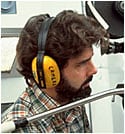 Lucas got the droid’s call letters from the shorthand for “Reel 2, Dialogue 2, “the heading on a cue sheet for the making of THX-1138. He took the character concept to artist Ralph McQuarrie, who was the origin of many designs seen in Star Wars. In McQuarrie’s sketchbook, the droid took shape as the icon he has become today.
It was more than a short leap from concept drawing to metal robot, however. The first man responsible for building a working version of R2-D2 for the cameras was John 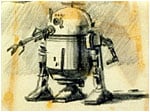 Stears, the mechanical effects supervisor for Star Wars. In 1976 when Stears approached animatronics experts for help in creating the droids of Star Wars, he was told that it
 ![[Early Ralph McQuarrie design for R2-D2]](https://popcornjedi.com/wp-content/uploads/2026/09/60.jpg) would be ‘virtually impossible’ to create mechanical beings with the functionality he described, even for a film, without many years of work. Stears gave up on the experts, and his crew had the robots ready in a few months. Admittedly, there were many difficulties with the experimental original working droids, especially in Tunisia, where their radio-controls often went haywire, but in the end the creations of Stears and his crew became a truly convincing set of cinema droids, and R2-D2 was the standout.
would be ‘virtually impossible’ to create mechanical beings with the functionality he described, even for a film, without many years of work. Stears gave up on the experts, and his crew had the robots ready in a few months. Admittedly, there were many difficulties with the experimental original working droids, especially in Tunisia, where their radio-controls often went haywire, but in the end the creations of Stears and his crew became a truly convincing set of cinema droids, and R2-D2 was the standout.
 Ben Burtt created R2-D2’s distinctive voice, and has long considered R2-D2 to be “the toughest challenge” of all his sound design work on the classic Star Wars Trilogy. “The trick was in finding a voice that sounded truly electronic, yet which had character and personality. The breakthrough came when I realized that Artoo should communicate with recognizable but inarticulate emotional sounds, kind of like a baby. When I added modified human-generated squeaks and sounds into the electronic mix, Artoo’s voice came to life. I always thought that all the extensive design worked well and created a distinct vocal identity, but you know I still get people asking me if I just used telephone touch tones.”
As with his counterpart C-3PO, part of Artoo’s charm came from a human actor inside him. Performer Kenny Baker was shoehorned into the little barrel of R2-D2 beginning back in 1976, and has returned to this role for Episode I. When you see R2 rocking from side to side, or doing certain little head turns, that’s Baker. His presence is important for adding a living touch to Artoo, and giving the metal creation that little bit of extra human personality.
However, unlike C-3PO, who is always given movement and character by a human actor, 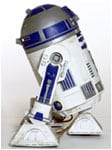 most of the time R2-D2 is played by an actual robot. And from the beginning, it has been a team of robots rather than just one. R2-D2 as we see him in the films has a lot of robotic capabilities — his head turns, lights blink and change color, an extensible third leg can drop down to make him a rolling tripod, he has various arms inside which deploy from body panels for extinguishing fires, interacting with computers, welding, clutching,
 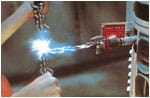 and whatever else he needs to do. He can roll along on hard surfaces or even outdoors across rocks and sand. That’s a lot of functionality to pack into a 20th century robot. It was too much to fit in just one body back in 1976, and it’s still too much today. As a result, for Episode I R2-D2 has been played by several different robots in addition to the “suit” worn by Kenny Baker, making for a total of about eighteen Artoo units for the film.
Creating the Episode I Artoo platoon began when several surviving original Artoo units from the classic Trilogy were shipped to Leavesden Studios during pre-production. One 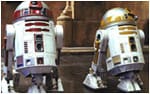 of the two original rigs made for Kenny Baker was used almost unchanged in Episode I, modified only to make it more comfortable. The rest of the Artoos were disassembled by the Leavesden crew and used to create new units, re-engineered for Episode I. Several have specialized purposes, such as the one which is capable of extending and retracting its third leg, a re-worked version of the original made for the classic Trilogy. Another was designed to travel through sand in Tunisia, which it accomplished with large, wide wheels which dug into the loose surface and gave the droid the ability to more or less “swim” through deep sand. Still another solved the problem of crossing deep sliding door thresholds with a complex rotating caster arrangement in the third leg’s foot pod. At the same time, some “generic” R2 units were also built and painted to look like red or green or yellow versions of the familiar droid.
To supervise the construction and operation of these new Artoo droids, Producer Rick McCallum found an individual with specialized experience: Jolyon Bambridge, who had become known as a talented radio control operator for film. Bambridge built animatronic animals for Zoo Family and television commercials, but did more spectacular work on behalf of James Bond. For the Bond film Goldeneye, Bambridge navigated extremely tricky radio-control helicopters, devices which can be very “hazardous to health” in the wrong hands. His latest work involves “model” flying helicopters eight feet long, which he is operating for the newest Bond film, presently in production. For Episode I, Bambridge was brought on board heading an Artoo mini-department within Peter Hutchinson’s physical effects department. Bambridge’s experience and expertise kept R2-D2 from banging into walls, and steered Artoo smoothly along with actors as they walked. (One doesn’t want a heavy droid accidentally rolling over an actor’s shoes or squashing their feet.)
 One new Artoo unit was created at Industrial Light & Magic during Episode I production, to add to the group at Leavesden. Long-time R2 operator Don Bies and a team of ILM specialists created a new unit with upgraded technology. This special ILM Artoo featured quick-change battery packs and a steerable large front wheel, yet another solution to making the droid [ILM’s new R2 unit]able to cross channels and door thresholds. To assist Don in navigating this Artoo, the new unit even included a miniature transmitting TV camera, so that the radio-controller could see “through Artoo’s eyes” even when a crowd of actors hid the droid from the operator, who stood just off-set. This unit, painted as a yellow Artoo in most scenes, completed the range of automatons on standby at Leavesden for Lucas’ call.
Navigating a radio-controlled Artoo unit is a specialized skill. The mobile robot weighs a couple hundred pounds, is not really as magically lucky as he appears on-screen, and is capable of getting into a lot of trouble. Bambridge recalls that one scene, shot in a woodland location in Britain, proved a bit too much for the hero droid he was operating. “We were shooting the scene, and Artoo had to creep in and stop just as the actors were delivering their lines. He ended up running over difficult tree roots and reached an incline that was just a bit too much. Right in the middle of things as he stopped, he toppled over and his head fell off and went rolling down the hill! The worst part was that it then happened again! Other than that he was pretty well-behaved.” On location in Tunisia, one long take showed R2-D2 traveling down a street, turning a corner, and then entering a doorway. No single vantage point would allow Bambridge to see Artoo all the way through the shot, so it took both him and a second operator stationed at a different points to control Artoo for the shot. They successfully used the innovative strategy of two control transmitters tuned to exactly the same frequency, one handing off Artoo to the next.
Back on the Leavesden soundstages, Bambridge and the other operators trying to steer their droids through crowds of actors and Naboo soldiers (and not-really-there CG Battle Droids) found that things eventually got a bit crowded. When an operator couldn’t see his droid, an extra playing dead on the floor might easily find himself in peril of being run down by a blind radio droid. To keep the extras in usable condition, better vantage points were devised for the Artoo operators, and they began to perch in stepladders or even 70 feet overhead in the stage rafters.
Trapped in the rafters between takes, some of the Artoo operators began to experiment. There was no concerted plan, but the operators began following each others’ lead. At first, the droids would simply chase around some of the crew members’ children visiting the set, sending the kids shrieking with glee. Later, the Artoo squad began shadowing George Lucas, quietly following him around the set like a bunch of awed, automated fans. “I wouldn’t know anything about that,” says Jolyon Bambridge, deadpan.
In the film, R2-D2 is simply a character, part of George Lucas’ colorful cast and a hero in his own right. All the people behind him disappear on-screen, their work creating a perfect illusion of a fantasy come to life–but it is their work that makes all of Artoo’s personality possible.