Wrapping, Chambers, Restraining Bolts, Mechy Works & Kate Jones

Welcome to a look Inside The Holocron. A collection of articles from the archives of *starwars.com that are no longer directly available.
(*Archived here with Permission utilising The Internet Archive Wayback Machine)

The piece explores early Episode I production work, focusing on the intricate mechanical elements, chamber setups and the practical engineering that shaped the film’s earliest phases. It highlights how these components were refined, tested and integrated into the broader production pipeline, offering a grounded look at the craftsmanship behind the machinery and environments.
It also reflects on the collaborative problem‑solving that defined this stage of filmmaking, noting how technical teams balanced design ambition with physical limitations while shaping the mechanical identity of the prequel era. The article’s archival nature adds a quiet charm, capturing a moment when Star Wars was rebuilding itself through hands‑on innovation.
 First Phase of Episode I Production Wraps at Leavesden Studios
September 29, 1997
 The first phase of filming on Star Wars: Episode I has been completed. Following the story of young Anakin Skywalker and the origins of the Star Wars Trilogy, the movie’s cast and crew have traveled from Leavesden Studios outside London to locations in Italy and North Africa, returning to the UK again for the important final scenes. The first phase of principal photography drew to a close on Friday, Sept. 26, and the cast and crew prepared to disperse after their filmmaking adventure together. Director George Lucas will see some of them again next year, however. Parts of the team will re-assemble at that time to carry out a planned phase II of shooting for Episode I
Jedi Council Chamber
October 1997
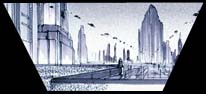
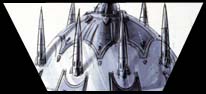 Somewhere high above the streets of glittering Coruscant soars the spire of the Jedi Temple. Star Wars: Episode I offers a visit to the inner sanctum of the noble Jedi Knights, the Jedi Council Chamber.
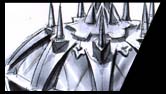 George Lucas wanted the Jedi Temple to stand out in the metropolis of the galactic capital world. He asked his art department to produce sketches of a distinctive and unique building that would suggest the special religious nature of the great structure. Ed Natividad created these visions of what the building might look like.
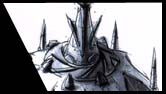 A crowning spire was a key feature of the design from the beginning, including a topmast and a ring of spikes.
The spire had to house a round room, with windows giving a view out over the cityscape of Coruscant. Various designs experimented with different looks and textures for the spire.
 A balcony scene written into the script necessitated the addition of at least one balcony to the spire. As various design concepts were presented, the topmast and ring-of-spikes motif remained intact.
This variant sported tripartite symmetry, with three balconies spaced around the room’s perimeter. Jagged angles have given way here to smoother curves and a more graceful, elegant look.
While the exterior continued to undergo refinement, Jay Shuster focused in on the design of the balcony, which had to be built for live action shooting in Leavesden. This design includes organic curves and a hint of Art Nouveau styling.
This design for an anteroom/hallway also features organic curves and light texture for interest and mood.
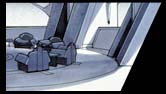 A ring of chairs for the Jedi masters is central to the layout of the Council Chamber itself. In this hallowed room is exchanged the wisdom of the highest of the Jedi order, their seating recalling the noble Round Table of Arthurian legend.
The ring of spikes motif seen in the exterior views of the Jedi spire is picked up here in the interior view of the council chamber, which has the spikes continuing down into the room as columns.
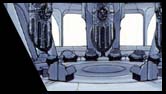 In this version, the spike columns were given heavily textured surfaces, employing a style reminiscent of Antonio Gaudi, architect of Barcelona’s Cathedral of the Holy Family in Spain. Later, George Lucas decided that the heavy texture of the spike columns was too distracting, and the set was altered to a smoother look.
That wasn’t the end of the design changes, either. Color, texture, and other details can all be changed later in digital post-production by ILM.
These sketches offer a window into an ongoing design process. “The digital revolution gives us a lot of freedom in creating and revising these designs,” said Doug Chiang. “After the live action was shot at Leavesden, George decided that he wanted to change some of the architectural elements visible out the windows of the Council Chamber, and open up the view behind the Jedi masters to show more of the city. So in post-production, these set elements will be digitally taken out and replaced. And because of these interior changes, we will now need to revise the exterior design of the Jedi Temple to reflect the new additions.”
The movie-making process has become fluid and non-linear, with design work continuing even after the wrap of principal photography’s first phase. Post-production and pre-production can now proceed simultaneously with all elements subject to revision and enhancement as the project comes together.
Why They Invented Restraining Bolts
October 2, 1997
Some of the droids on the set are real robots. When Kenny Baker is not assisting his good friend R2-D2, even R2 is all metal inside. These remarkable mechanical droids can speed around the sets with great enthusiasm, blinking their lights and looking around with their electronic eyes. Unfortunately they are, in fact, totally blind. This means that if you are an actor or extra in a battle scene, you have more to fear from a charging R2 unit than from the prop guns in your enemies’ hands. The laser beams will be added in a year from now by the wizards at ILM. R2, on the other hand, is coming right at you, blinking like mad.
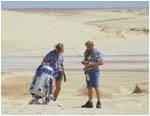 Your only hope is that the droid operator has been given a good place to stand for this scene. Droid operators ring the set, holding complex, custom-built remote controls, directing the actions of their robotic charges. When these operators get good vantage points, they are experts at making their droids behave like real characters in the scene. In the midst of a pitched battle scene, however, the view can get a little blocked, and at least one sturdy R2 unit has plowed right into an unsuspecting extra lying helpless on the floor from a fake blaster bolt.
Ladders were brought in to elevate the droid operators to new heights of status and observation, and now even in dense battle scenes the roaming R2 units act as if they have intelligence and concern for human well-being. They are now our reliable friends and allies, no longer rampaging renegade machinery. Our actors are perfectly safe from droid menace. The extras, however, still give them wide berth.
The Leavesden Mechy Works
October 6, 1997
The alien creatures inhabiting the worlds of Episode I are brought to twitching, blinking movement through the artistry of a special group of people known as “mechies.” These busy artist-technicians inhabit our animatronics department, and combine a variety of talents and backgrounds to turn foam and rubber into living characters.
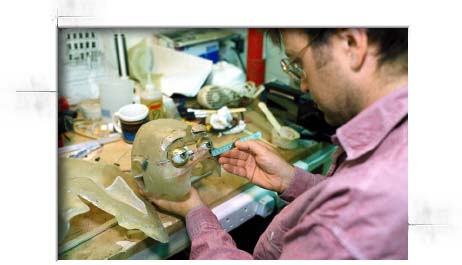
The animatronics department is one of the most interesting places at Leavesden, littered with batteries and lights and springs and wires, and skulls and teeth and ears and eyebrows. It’s not hard to imagine that these people could build a real, fully functioning droid. There are remote control units everywhere, and along with the blaring music (which the mechies seem to require to be able to work) there is the omnipresent whirring sound of tiny motors being put through their paces.
Everything here is wonderfully tactile. There are no lines of code being written here, no smooth computer rendering…just real sculpting and real wiring. Beneath the silicon masks of the creatures are metal muscles and tendons capable of an extraordinary display of articulation. Some characters are literally capable of lip-syncing human speech.
In the shop the mechies are all hunched over their creations, further fine-tuning the movements. The artists take great pride in finding the most elegant way to solve the problems of facial motion, each striving after the “Sexiest Mech of the Week” award for the most impressive innovation. One week the award may be for a brow-furrowing mechanism, the next week for an eye-rolling device.
With the exception of the batteries and stock parts like the nuts and bolts, everything is handmade here, and each mechanism reflects a particular mechy’s style. Unless certain creatures have to be mass produced, each mechy will approach the problems in their own way – meaning each person has his or her own technique for mouth movements, eye blinking, and so on. Thus, if only two creatures of a particular alien species have to be made by two different mechies, their resemblance is literally only skin deep – below the surface there are likely to be two completely different mechanisms producing the same result.
Each mechy is able to control his mask with great dexterity. They usually work with the actor underneath the mask to try to lip-sync the dialogue. This means that with their remote control units they must keep up with the actor’s speech and reproduce the proper mouth movements on the fly, via their remote control units. They are therefore remarkably fast and agile with their buttons and joysticks.
Some of the masks are extremely complex, and require not only the movement of the actor wearing the mask but also several remote control units, and soon one creature’s speech and facial expressions become a complex three-man job, where all three need to be in perfect sync with each other. When done right (which it almost always is, of course), the effect is stunningly life-like.
Mechy work attracts people from a surprising variety of backgrounds, from horticulture to graphic design. In spite of the resulting individuality of mechy work, however, there are a few principles that unify their work. One trait they all seem to have in common is a knack for finding simple, elegant solutions to complex problems. All the different kinds of circuitry and wirework the mechies devise is alike in that it is clean. There is nothing superfluous. The masks are made to be as simple and lightweight as possible, and most of the motor and battery work is in fact worn on the back, with just the wirework extending into the mask. This way the mask can conform to any shape, without having to make room for motors. The range of solutions and problem-solving approaches amongst the mechies is as remarkable as the illusions of life they help to create.
Animatronics creatures like Yoda will continue to hold an important place in filmmaking even as computer graphics become increasingly sophisticated. The mechies pour themselves and their personalities into their work, infusing personal, hand-held nuances to their projects. These subtleties and this physical, human touch help transform creatures into believable characters, making them – and the story – come alive for the audience.
Kate Jones: Actors’ P.A. Extraordinaire
October 7, 1997
Kate Jones is a special Production Assistant (P.A.) for our actors. You see, while the actors are busy acting, or getting fitted for costumes, their home lives are often facing even more serious challenges. This is where Kate comes in.
 Actors usually have to work for months on end, on movie sets that are far from home. Entire families are uprooted and forced to find temporary homes in their new surroundings. Oftentimes this is in a foreign country where daily life is dramatically different from what they are used to. Possessed with a strong motherly instinct, she tries her best to make the transitions a little bit easier.
Miss your Nintendo system? No problem. Kate’ll get you a new one. Want exclusive Wimbledon tickets? Kate has connections. Interested in taking ballet lessons from the very best? Easy. For Kate, it’s just a phone call away.
Kate has notes on everything – how to fix a refrigerator, how to set up a home satellite video conferencing system, how to build a tent city in the desert, and so on. Even more impressively, she seems to be able to produce any of this material on a moment’s notice.
Basically, there is nothing that Kate Jones, Actors’ P.A. Extraordinaire, can’t track down or cobble together – though we did have some trouble with the complex mystery of peanut butter and jelly sandwiches. Apparently this life-giving staple of American youth is unknown amongst British children. While Kate was able to locate the required ingredients, our young Anakin Skywalker – Jake Lloyd, together with his sister Madison, had to demonstrate how one is properly made.
Kate, of course, took copious notes.