

This archival feature examines how the Star Wars saga was meticulously restored for the Blu‑ray era, detailing the extensive work required to bring the films into high‑definition for a new generation. It explores the challenges of scanning original elements, repairing decades of wear, refining visual effects, and enhancing sound mixes while preserving the integrity of the original releases. The piece highlights the technical artistry behind the transition to HD and the collaborative effort across Lucasfilm divisions to ensure the saga’s presentation met modern standards without losing its cinematic legacy.
Archived here with Permission utilising The Internet Archive Wayback Machine. A premium curated compilation of historical galactic data manifests.
|
The Best on BD |
|---|
| The Best on Blu-ray: Restoring the Star Wars Saga for the HD Generation
The Phantom Menace Revisited
Fode and Beed, the two-headed announcer of the Podrace, for instance, suffers an anatomical anomaly unique to digital characters. At one point, his hand intersects with his body. This was corrected frame-by-frame for the Blu-ray edition. 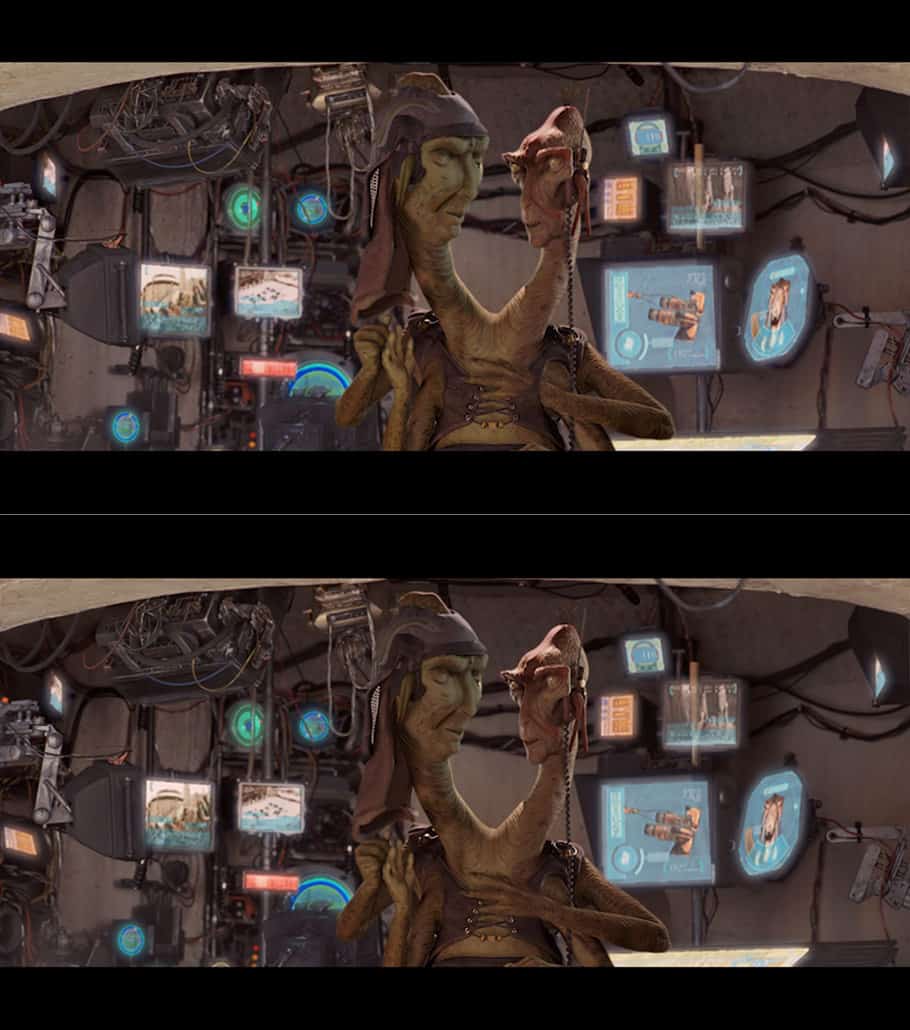 Episodes II and III
Episodes IV, V and VI The older films of Episode IV, V and VI required special care and attention. Already, for the 2004 release, the movies underwent significant digital restoration to have them align with George Lucas’ vision of the six Star Wars movies being a single, seamless presentation. However, that is not to say that that work done for the 2004 release was simply ported over to Blu-ray.
“It went through three phases of QC (quality control) processes,” describes Diane Caliva, Production Manager for Media Operations at ILM. “In addition to Lucasfilm reviewing, there were outside companies hired as well. The first was Blu-focus/THX QCing our masters. Then it went through Deluxe and their QC process. And at last was The copious QC notes would identify subtle defects in the picture and sound. Most of the work done on Episodes IV, V and VI are subtle restorative touches — the correction of blemishes and warping on the image, dirt removal from old transfers and such. Side-effects of the optical compositing process — like the gray “garbage matte” boxes that occasionally surround the TIE fighters of Episode IV, for example, were reviewed on a case-by-case basis. And, like Episode I, there would be a few surprises that had remained hidden in the movies for decades.
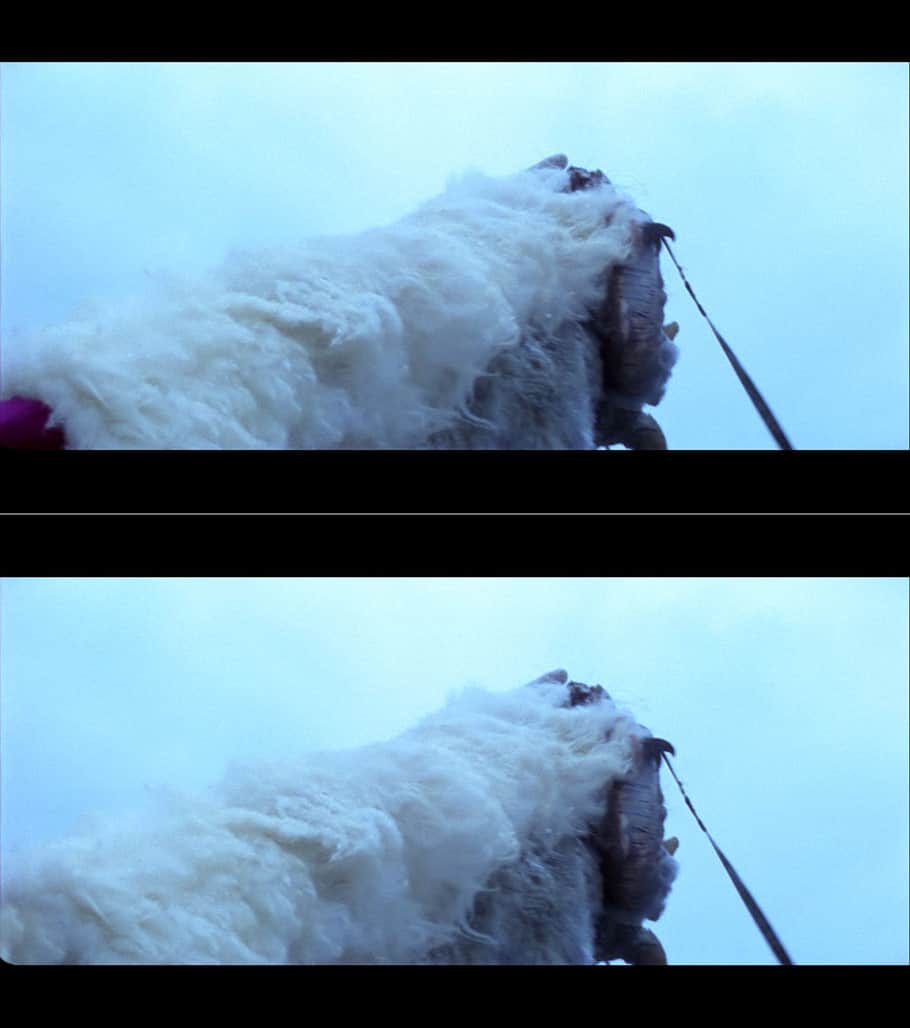
A longstanding picture error that occurs during the TIE fighter attack on the Millennium Falcon was finally fixed. Right before Han nails the last TIE fighter dogging his ship, his laser blasts zap into the empty spaces between the TIE’s wings. There are a handful of such technical shot corrections in addition to the cleanups throughout the films. For The Empire Strikes Back, there was less work required, but one nitpicky error has been addressed. The very edge of frame makes it evident that the wampa arm that attacks Luke is mounted on a puppeteer’s arm. This has been corrected.
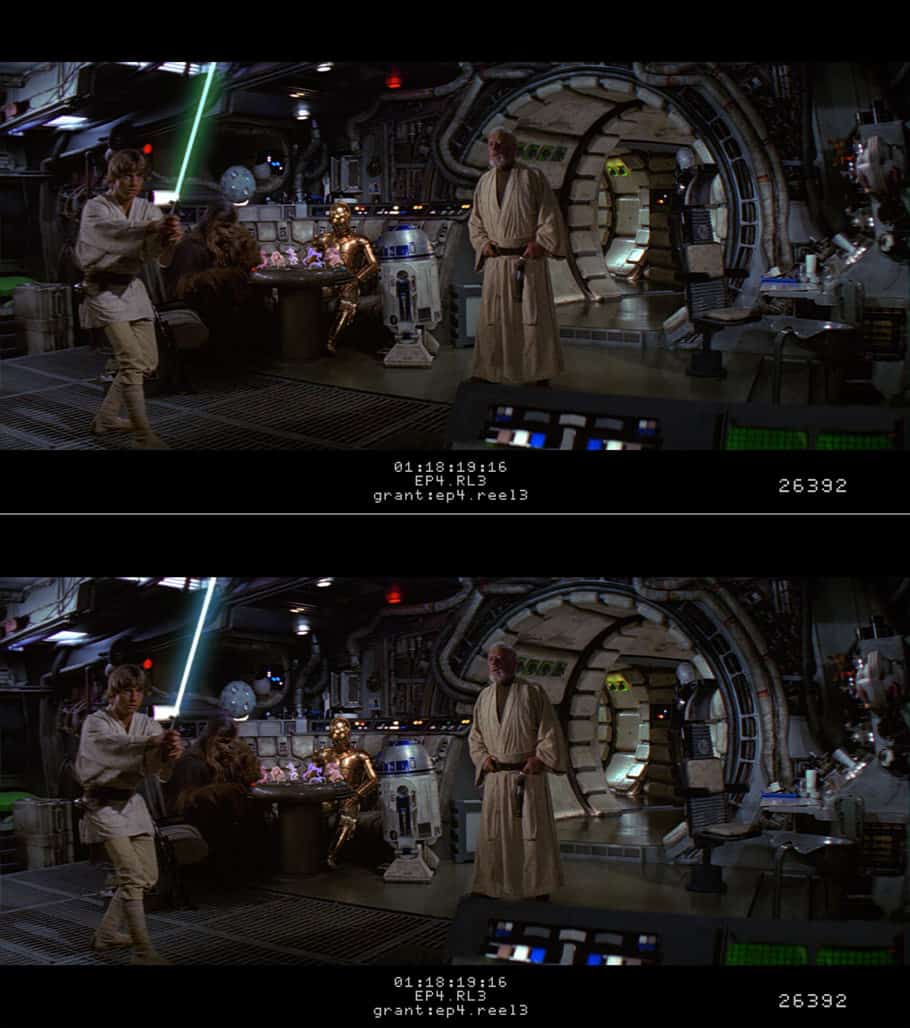
“Some of the issues come from these movies being finished for film and projected for film, and that’s how people saw them. A lot of things that look a little different on HD or DVD are really the nature of how video treats color space,” explains Huebler. A dramatic example of this came up in the 2004 DVD release, with the dimming of the lightsaber cores throughout the trilogy, even to the point where Luke’s lightsaber aboard the Millennium Falcon shifted from blue to green in Episode IV.
Issues such as these have been corrected, most notably in Return of the Jedi, when Luke and Vader’s lightsabers cross in front of the Emperor’s face. With the blades dimmed, the hand-animated nature of the lightsabers became too apparent, and the sabers failed to register properly at their intersection point.
In the theatrical release, the light of the darkened theater experience did not make these blobs look too apparent, but the eventual home video release of Episode VI made them very obvious. Home televisions couldn’t be calibrated as finely to hide these animated shadows, and many viewers who watched and rewatched Return of the Jedi on VHS or DVD couldn’t help but notice what came to be nicknamed in the fan community “the Emperor’s slugs.” These visual defects have been eliminated with a digital shadow that better matches the surrounding frame.
“There is a lot of what ends up being ‘invisible’ fixes,” agrees Huebler. “That’s the goal: when it’s invisible that you don’t notice that something glitched or there was a mistake. That could be very challenging to get to, as each one has its own creative decisions.”
|
 Though the Star Wars movies were created for the big screen, George Lucas and his production team have made efforts to ensure they look and sound as good as possible for their home video releases. With the Saga’s long-awaited release on high-definition Blu-ray disc this September, it will be arriving in the best looking and best sounding home video format ever, a release that required meticulous optimization of picture and sound.
 It’s not without precedent. The 1993 Laserdisc set saw the inclusion of a new sound mix that took from the best of what had come before. The 1995 VHS release underwent the scrutiny of a then-new THX home video review process. The 2004 DVD launch of Episodes IV, V and VI saw a concerted restorative effort to bring the picture and sound up to the digital clarity that audiences now expect from Star Wars. The unprecedented quality of the Blu-ray experience required even more investment.
 After numerous tests and comparisons of different conversions of the filmed Star Wars movies, the restored high-definition masters were selected as a starting point for artistic preferences. But even with these carefully restored masters, there was still room for restoration to ensure the best quality Blu-ray presentation from these.
 Surprisingly, one of the more recent Star Wars movies benefits the most from Blu-ray. When Star Wars: Episode I The Phantom Menace arrived in theaters in 1999, it presaged the birth of digital cinema. Though it boasts over 2,000 visual effects shots featuring digital animation, environments and compositing, Episode I was captured and released on film. Its 2001 DVD release — the first Star Wars movie released in the DVD format — was acclaimed for its picture and sound quality at the time. But the expectations for home video picture quality a decade later are so much higher that Episode I now looks the most dated on DVD.
 “When they did the transfer from film for the previous DVD, they wanted to make sure they got rid of frame edges, artifacts, splices or what have you,” says Dorne Huebler, an Associate Visual Effects Supervisor at ILM involved in the Blu-ray restoration. “So they were pretty aggressive about the blow-up.”
 A blow-up is a magnification of the film image done to avoid displaying the edges of the frame. The Episode I home video magnifies the image to such an extent that approximately 8 percent of the picture is missing. In certain shots in Episode I, there are characters from the edge of frame that are gone in the DVD release, and have now been restored for the Blu-ray.
 “When we started restoring the film at this stage, we went back to the original digital files rather than the film-outs,” continues Huebler. “And because of that, we could be much more selective about minimizing the blow-up. You’re seeing more of the image. It’s cleaner and crisper. Throughout the film, it’s a lot more pristine. It’s probably the best it’s looked.”
 Expanding the picture and revisiting it in high-definition also surfaced some longstanding visual effects and technical errors that had gone undetected in the past. Though not every shot has been revisited (there are 2,000 after all), some have been corrected for this release.
 “Ironically when you see things in HD, it’s not forgiving in the way film can be,” explains Huebler. “Flicker, grain and projector weave naturally disguise certain nuances when viewing film. We’ve really gone over shots with a fine-toothed comb and discovered issues we could improve with a bit of TLC.”
 Episodes II and III had the least amount of correction and restoration required, as they were captured and released in high-definition digital video from the start. The team at Lucasfilm is better positioned to directly transfer the image and sound from their source to Blu-ray for Attack of the Clones and Revenge of the Sith. Though the movies were meticulously reviewed, there weren’t as many surprise picture defects that required addressing.
 “The pipeline really changed between Episode I, which was more of a conventional process early in the era of digital filmmaking, and Episodes II and III,” recalls Huebler. “I remember, because Episode I was the first project I worked on here at ILM. At the time, our technology and our pipeline allowed us to see dailies on video at a lower resolution. When a shot was approved, we usually went straight to film. That changed when we went to HD for Episodes II and III. In that sense, it was much more of a what-you-see is what-you-get in dailies. You could scrutinize it. With film, you can’t stop on a frame as easily, or zoom into it to take a look at things. But with digital, you can.”
 the emulation phase, by the Deluxe team . We would get ‘kickback notes’, and then Dorne and our team we would assess the shots, and go in and clean up the files.”
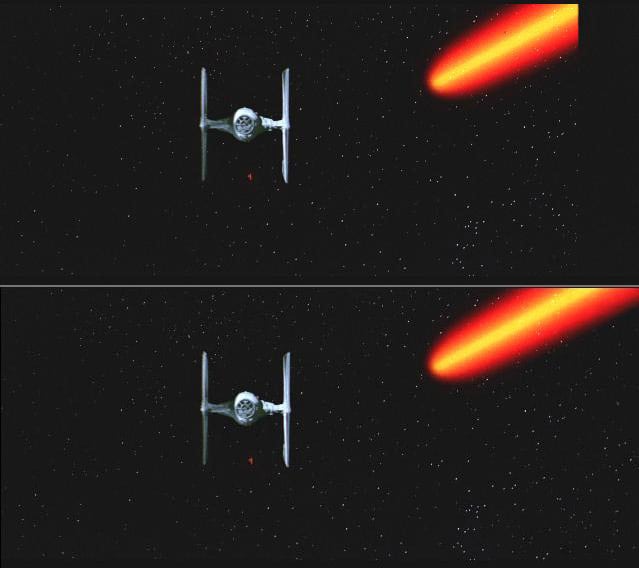
 But as the TIE flies toward camera, nearly a third of the frame has been left black and empty. “It has always been missing,” says Huebler. “Looking at it, what I think we were seeing was an image that had been flopped way back at the time, and you were seeing off into the soundtrack area [of the frame]. Because it was star-fields on black, it was subtle enough
 that it didn’t catch people’s eye. That one was kind of fun to do: we tracked in a star-field to match, and extended the laser-fire so it didn’t get chopped off.”
 “We’re trying to get back to the intention of the original film experience,” says Huebler. “That’s really what’s going on with the lightsabers. You want that hot white core, and it was just right for film, but on video, that was dampened.”
 Revisiting the lightsabers in Return of the Jedi gave ILM the opportunity to fix a longstanding visual defect from the 1983 release. During the filming of Jedi, there was something unsatisfactory about the final close-ups of the Emperor — something objectionable about the way Ian McDiarmid’s makeup looked or the light played on the side of his hood. So, George Lucas opted to “fix it in post,” a risky move in the pre-digital days. A hand-animated shadow was drawn during all of the Emperor’s close-up, an odd black blob that danced on the edge of his cowl.
 “When you’re reviewing shots as they were meant to be in a theater in real-time, you don’t see these things,” says Caliva. “But now that people have Blu-ray and they can go frame-by-frame, you see more issues.”

This High Republic archive fragment was recovered from the frontier outposts of Elphrona…(Naaaah, YOU know where)
Please Share this post:
- Share on X (Opens in new window) X
- Share on Tumblr (Opens in new window) Tumblr
- Share on Mastodon (Opens in new window) Mastodon
- Share on Bluesky (Opens in new window) Bluesky
- Share on Facebook (Opens in new window) Facebook
- Print (Opens in new window) Print
- More
- Email a link to a friend (Opens in new window) Email
- Share on Threads (Opens in new window) Threads
- Share on Reddit (Opens in new window) Reddit
- Share on Pinterest (Opens in new window) Pinterest
- Share on LinkedIn (Opens in new window) LinkedIn
- Share on WhatsApp (Opens in new window) WhatsApp
- Share on Nextdoor (Opens in new window) Nextdoor
- Share on Telegram (Opens in new window) Telegram