
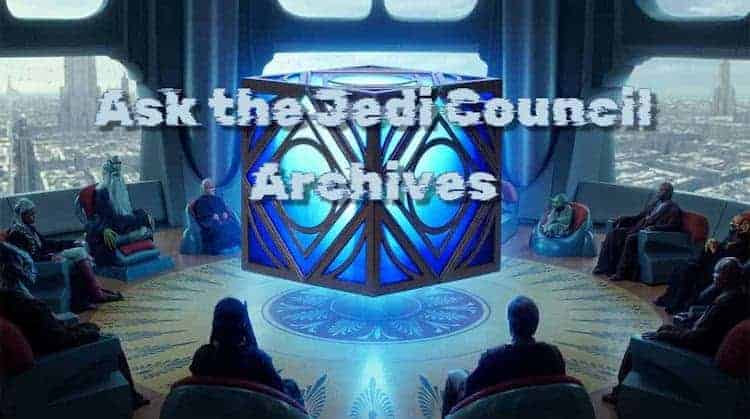
Step Into 2000 — The Jedi Council Is In Session
Welcome to the Ask the Lucasfilm Jedi Council Archives. A feature of *starwars.com no longer directly available. This is not a complete archive in regards to images and such but I have salvaged everything else that I was able to and can now say I have found ALL of the questions that were asked of the esteemed council!!. 
(*Archived here with Permission utilising The Internet Archive Wayback Machine)
Step into the Jedi Council Archives circa 2000 — a time when Episode II was still a bundle of concept art, casting debates, and cutting‑edge tech experiments. These preserved Q&As offer a rare peek behind Lucasfilm’s blast doors, capturing the ideas, curiosities, and creative chaos that shaped the prequel era. Think of it as a time capsule from the dawn of digital Jedi, where lore, design, and early motion‑capture magic were all taking shape.


Q : You’ve got a couple of guys on staff who came to you right from high school. How did they do that? Is there hope for others to follow?
Q : How much of the real world goes into Star Wars designs?
Robin Gurland: The stunt director selects his stunt team. In England, the assistant directors select the extras, however in the U.S. a separate extras casting department chooses the background players. All departments confer with each other to maintain a sense of continuity of look. Q : Can you explain motion-capture technology? What are its best uses and current limitations?
The advantage of motion capture is its ability to record every detail of a performance. So it is a great way to animate realistic characters that need to move exactly like people or animals. Motion capture is not as useful for animating cartoony characters, or animals that would be impossible to capture. These kinds of characters can be animated by artists who create the illusion of realism by carefully posing the digital characters in each frame of the animation. Q : One of the most unforgettable sequences in The Phantom Menace is the Podrace. How did the stadium design come about?
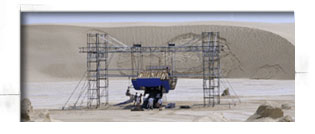
Incidentally, the pit hangar design grew out of my inspiration that these Podracers were very much like horses. So I initially designed the starting line to be like starting gates with individual stalls, similar to those found at horse tracks. The finished pit hangar incorporates the stall idea, which anchors the design in something that we are familiar with.
Robin Gurland: Due to the large amount of voice-over casting, I was casting those roles during principal photography. At the same time I continued casting day-player roles and roles that needed to be recast due to conflicting actor schedules. Through post production, I worked with the sound team when they had ADR (sound looping) sessions. Q : How did you go about deciding how much of a real set to build and how much will be blue screen, to be used in “building” the rest of the set in the computer?
Despite the large use of the digital technology on EPISODE I, we still built approximately 64 sets, which sometimes filled whole stages at Leavesden. Maybe on Episode II different decisions will be made as technology has again moved on. Q : So many fans want Episode I and then the Classic Trilogy on DVD. It doesn’t make sense to us that you aren’t going to release at least Episode I. What’s going on?
Robin Gurland: I was introduced to Rick McCallum at a dinner when he was producing the Young Indiana Jones Chronicles. We built up a rapport and when it was time to begin casting for Star Wars: Episode I, he remembered me, gave me a call and the rest is history. Q : Many visual effects techniques for The Phantom Menace had never been attempted before. How much new technology and software needed to be developed to carry out what was required. Who does that kind of work and how long does it take?
Q : How specific is George Lucas in directing the design of a character or vehicle, and how much freedom does he allow the artist?
Q : Why didn’t Qui-Gon Jinn disappear when he died?
Yet we see Qui-Gon killed by Darth Maul, then the flames lapping at his body at the temple on Naboo. No, this is not a continuity error. And yes, George Lucas does have a reason for treating these Jedi deaths differently. “There is a whole issue around that and the ability to disappear,” he says. “The key line to understanding this is when Ben Kenobi tells Darth Vader, ‘If you strike me down…’ And it’ll be explained as we go along.” So we just have to wait a while longer. In the meantime, feel free to speculate. February 2000
Gavin Bocquet: There are many different ways of turning the concept ideas into actual set designs. Sometimes we took the drawings directly from Doug Chiang’s concept group, and interpreted them very precisely into a three-dimensional full size set. Other times, as with Gunga City, we took the initial idea of an underwater bubble city, and came up with numerous design ideas, in model form, to show to George Lucas. These design models would gradually become more sophisticated until we had enough information to start thinking about how we would achieve this as a full size set.
ILM: There were a variety of materials used in the construction of the model work for The Phantom Menace ranging from the usual man-made materials such as plastics, aluminum and steel to materials that come from nature, such as sand, plants and wood. The shot requirements and business economics often dictated what materials were selected for the construction each project.
Rick McCallum: We’re already filling just about all the production slots with great crew from Australia and some of my crew chiefs who are returning from Episode I such as Production Designer Gavin Bocquet and Costume Designer Trisha Biggar. It’s a lot easier to figure out what’s up and what’s needed at both ILM and Lucasfilm by going to their websites: www.ilm.com and www.lucasfilm.com.
Robin Gurland: I watch LOTS and LOTS of films and television, see as much theatre as I can, keep up with the trades (entertainment industry newspapers) and the popular magazines, and am always on the lookout.
Steve Sansweet: The Star Wars galaxy is a huge one, so large that not even an encyclopedia or a Jedi Holocron could contain all knowledge. Among the current mysteries are the species of Jedi Master Yoda, the female Jedi Council member Yaddle, and the Sith Lord Darth Maul. Perhaps in time those mysteries will be resolved. Perhaps not.
David Dozoretz: As with all 3-D computer animation, the artist tells the computer where a virtual object (whether it is the camera or Anakin’s Podracer) should be at the first frame of the shot, the last frame, and key frames in between. The animation program will then fill-in the frames in the middle, a process akin to the traditional cel animation technique on “in-betweening.” Q : Were there any sets or designs considered for Episode I that were dropped because of time or budget constraints?
Rick McCallum: Ray Park did a fabulous job for us, but didn’t you see the dude get sliced in half at the end of the film? Would he come back as two halves? I’d love to work with Ray again, but at this stage there aren’t any plans to do so. Q : What architectural influences are present in the buildings of The Phantom Menace?
March 2000
Steve Sansweet: Yes, and yes. Despite the huge importance of computer graphics in The Phantom Menace, there were more costumes and physical props made for Episode I than any of the other Star Wars films. In fact, the size of the Lucasfilm Archives, first set up as a separate entity around the time of Return of the Jedi, just about doubled following Episode I to around 40,000 square feet. For full details, see our recent Visit to the Archives feature on starwars.com. As for display, a few of the props are currently making the rounds of the U.S. as part of the two-year museum tour, Star Wars: The Power of Myth, under the auspices of Lucasfilm and the Smithsonian Institution Traveling Exhibition Service. It opened at the Minneapolis Institute of Arts Feb. 27 and moves on to Chicago’s Field Museum July 15. In London, a separate all-new show highlights many more of the Episode I props and artwork along with many never before publicly exhibited Classic pieces that show The Art of Star Wars. It opens April 13 at London’s Barbican Centre. Additionally, some of the Episode I costumes are currently on display free of charge at the Los Angeles’ Fashion Institute of Design and Merchandise sponsored by the Art of Motion Picture Costume Design until April 28, 2000.
Doug Chiang: We had weekly meetings with George, usually on Fridays, where George would review all the week’s designs. I would often give George three directions to a design – a conservative idea, an extreme idea, and one in between. George would then select the one that best fit his needs and I would then expand on it for next week. Often through this process, we can hone down an idea in several weeks.
Steve Sansweet: There could never be one map that would encompass such a vast galaxy in its entirety. But the first true maps of the galaxy appeared in the LucasArts productions, Star Wars: Behind the Magic and the Episode I Insider’s Guide. These were the basis of a wonderful print map that appears as the endpapers in the great new R.A. Salvatore novel Vector Prime, which also includes many of the most important planets that figure in the films and the major novels. Q : Do you think animatics will totally replace the hand-drawn storyboarding process in the future?
Q : Do you think that digital animation technology will advance to the point where a digitally rendered character would seem identical to a human counterpart?
Gavin Bocquet: On most films, the sets are usually destroyed as soon as production decides they are not required for anymore shooting . On Episode I, because we knew there would be some planned re-shoots, and also that we might need some elements for Episode II, some of the sets were packed up and stored for possible use at a later date. As we get more information about Episode II, we will be able to decide which of these stored sets we need to keep. Q : Original trilogy concept designer Ralph McQuarrie established the look of Tatooine and Mos Eisley. Was it important to differentiate the look of Mos Espa in Episode I?
Q : What changes and new developments in digital effects technology can we expect in the near future? What might be some of the next breakthroughs?
The research is also very hot in the field of character animation, where the ultimate goal is to be able to perfect the look and the performance of a wide range of CG characters, from furry animals, to aliens, to human beings. Finally, there is always a need to produce visual effects more cheaply by simplifying or optimizing existing proven techniques. Although this research isn’t as spectacular, it allows the creation of images of much higher complexity, such as the ground battle, and permits much larger volume of work to be produced within a given budget, as was the case for The Phantom Menace. Q : What role did animatics play in helping to determine certain final actions on screen in Episode I?
Robin Gurland: General coloring and eye color – along with a facial structure likeness will suffice. April 2000 Q : What was the most challenging element of Episode I to conceive and draw?
Gavin Bocquet: Very simply, the Art Director (or Supervising Art Director) is the Production Designer’s main assistant, or right hand person. They help organize and run the Art Department, they do the schedules and the budget, and generally support and help the Designer in any way they can. For some, Art Direction is a good fit while others aspire to become a Production Designer, as I did. Q : How do you incorporate the art department’s conceptual designs into animatics?
Robin Gurland: Qui-Gonn Jinn was always in the script. Q : How do you find all of those wonderful places for location shooting and what is your favorite place you have found?
Once we had narrowed this down to a number of good possibilities, then Rick McCallum and I would travel to these countries and photograph and video all the different possibilities. Then we would bring that information back to show George, and he would start to choose specific locations for the film. It is hard to say which location is my favorite, as every new place you travel to can seem to be the most exciting whether the grand architecture of Italy or the deserts of North Africa. But I’m always amazed whenever I travel to Africa. It is such a beautiful continent.
Rick McCallum: If you add up all the Internet and gossip column and magazine rumors, we’ve cast about 37 Anakins. In fact, we’ve cast none. We’re very active in the casting process now and we’re going to come up with the actor who best fits the part that George has written and who best works with the actors who will be continuing with us such as Natalie Portman and Ewan McGregor. We’ll let you know when we’ve filled the role. Q : What were the inspirations for the design for the Naboo starfighter?
Q : I’m excited that Boba Fett is going to be in Episode II. Are we going to get more details about how he was once Jaster Mereel and killed another Journeyman Protector on the planet Concord Dawn before becoming a bounty hunter?
My advice: Forget everything you knew, or thought you knew about the origins of Boba Fett. While none of us have seen a script of Episode II or have an idea of the direction in which George Lucas is taking the character, it’s fairly safe to say that he won’t be held to any of the back stories that have arisen over the years to try to explain the roots of this strong, mostly silent type. If there is any hint of Fett’s beginnings, it will be all George. At the same time, what you’ve read to this point was probably misinformation anyhow. A bounty hunter like Boba Fett has much to gain by having numerous myths of his origin in circulation among potential employers and potential victims. That is why the Star Wars Encyclopedia states: “Many tales are told of his background and exploits, but there are very few verifiable facts, perhaps by design.” Fett’s short career as a law enforcement officer on Concord Dawn, and his perhaps-unjust downfall, was first told in Tales of the Bounty Hunters. Dark Empire II speculates that he was formerly a stormtrooper who killed his commanding officer. The Marvel Comics series has Fett as an ex-Mandalorian commando, a veteran of the Clone Wars alongside Fenn Shysa and Tobbi Dala. Marvel even went as far as showing the lush jungles of the planet Mandalore. As many fans know, when it comes to Star Wars knowledge, there are degrees of “canon.” The only true canon are the films themselves. For years, Lucas Books has stayed clear of characters, events, or the timeframe that George might want to deal with in the Star Wars prequels. While such things as the Clone Wars, the fall of the Jedi, and Palpatine’s rise to power were on that list, Boba Fett wasn’t considered to be of major concern. But like any great storyteller, George starts to develop a script and it sometimes takes on a life of its own, with characters coming to life and demanding a say. He has told us that Boba Fett will have a role in Episode II–just as Fett first appeared in the second film of the classic trilogy–so we may finally learn the bounty hunter’s true genesis. As for whether Fett really survived his descent into the cavernous maw of the Sarlacc in Return of the Jedi…what do you think?
David Dozoretz: Happily, technology has progressed to the point that anybody with a video camera and a computer can make a short film or learn computer animation. When hiring animators, I’m less interested in which specific computer or animation program they use, and more interested in the story-telling abilities of the artist. The software will always change, and they all generally do the same thing in different ways. The important thing is to have something to say. I see hundreds of demo reels of animators who have ten unconnected shots of spaceships of logos. I’d rather hire someone who has told me a story. So the short answer is…study film. Learn the computer animation programs as well, but definitely spend your education studying the history and language of cinema. And art. This will make you a much better storyteller, which is the whole point of animatics. May 2000 Q : How are all the props made and what types of materials are used?
For props and dressing there are no rules about what you can and can’t use to make them. It has to look good, it has to function correctly, and it has to be made as inexpensively as possible. Sometimes, you design something very specifically. This design is then drawn up and a technician makes it to the specification of the drawing, using whatever materials and techniques are best for that piece. Other times, you will use various pieces of junk or scrap and build something from all these pieces. If you need more than one, then you might mold more from the first one. We also buy everyday objects from shops and stores, and then change them in some way to make them a special looking prop for us.
ILM: ILM’s prime platform is SGI. We have developed an extensive toolset on the SGI platform and have a long history of generating cutting edge effects utilizing its strengths. Artists work daily in front of O2 workstations and leverage the power of a 768 processor Origin2000 supercomputer to guide their judgment and artistic vision. At night, artists submit work to a 1400 processor super cluster which renders photo realistically and seamlessly places computer graphics into a scene. This requires the flow of many terabytes of information and the precise execution of millions of graphics operations under automated control: 365 days a year… all while you sleep! This is the ‘Industrial’ in Industrial Light & Magic. The power of ILM’s computational capability is second to none in the industry. We take great pride in our ability to harness this power and quickly generate synthetic environment indistinguishable from ‘the real thing.’ Entire motion pictures made from completely realistic, natural looking computer graphics are within our grasp!
Rick McCallum: No changes were made to The Phantom Menace in bringing the movie to video. Reports of changes or missing scenes are probably from fans remembering it differently because of the change in viewing environment. Also, the standard pan and scan version has to clip the edges in order to compensate for the different shape of a television screen compared to a wide movie screen. So, some of the great background details are unfortunately lost. That’s one of the advantages of the widescreen version included with the collector’s edition.
Rick McCallum: The Jedi have a very important and active role to play in the events of Episode II. You’ll be seeing a lightsaber or two. I think you’ll be pleased with what George has planned. Q : In what ways do the security measures for keeping Star Wars designs secret make your team’s job more difficult?
Q : How long ago is a long time ago? And how far is the galaxy that’s far, far away? Was this ever decided or is the concept just left open to our imagination?
George could answer a lot of the fans’ specific questions, either in the films or spin-off fiction, but deliberately doesn’t. Some of the answers are in his notes and binders, others are in his head. But speculation, he believes, is healthy. It helps to create a broader, denser Star Wars galaxy and gives fans more of a sense of ownership–rightly so. Being less restrictive also lets individual’s creative juices flow and pushes their imaginations. Over the years Star Wars films and spin-offs have inspired creativity and creative careers in countless men and women all over the world.
Gavin Bocquet: George has always been really keen to use real locations where ever possible, whether it’s the deserts of Tunisia, the snow fields of Norway, or the grand architecture of Italy. He feels strongly that you could not possibly create the variety and styles of imagery that you find in natural environments or existing architecture, which in turn then gives the look of the film a real integrity. Of course, some of the audience will recognize some locations, but when they are engrossed in the story and characters, then these backgrounds just look more real because they are.
Doug Chiang: Absolutely. Ralph, along with the other original designers, created unparalleled designs for Star Wars. They have been an incredible influence on me personally and will always continue to be. We are very fortunate to have his incredible body of work to fall back on for inspiration when we are stuck. You can see Ralph’s influences in Episode I on Coruscant as well as Tatooine. Q : How does the bluescreen technique work?
To pull a bluescreen we have to identify which pixels in the footage are part of the bluescreen element and which are not. Usually this is done by the computer using a set of rules, such as, if a pixel has more blue than both red and/or green, then the pixel is considered part of the bluescreen background. Once the program decides a pixel is bluescreen then it turns it transparent or “see-through”. The foreground person or object can then be composited on another background to make it look like they were always in the same shot; we don’t see the bluescreen any longer because the bluescreen is meant to “see through”. After we decide which pixels should be seen we also have to perform a step called “suppression” or blue spill removal, which is the process of taking the blue out of the pixels around the edge of the object(s) being extracted from the bluescreen. Even on the best lit bluescreen shots, the pixels around the edge of the object or person still get corrupted with blue color that reflects from the bluescreen. If the blue fringe isn’t removed, the object being extracted looks cut out and obvious against the new background plate because of the blue rim around the edges. The job becomes more difficult when the bluescreen fabric is unevenly lit, has seams in it, has water spraying over it, or even when transparent objects like a glass of water are part of the foreground. These situations present problems because it isn’t clear whether the pixels are part of the bluescreen background or not. For example, the glass of water sitting on a table might reflect some of the blue light from the bluescreen. The computer will think the reflection is bluescreen because of its color and make the glass transparent. In reality the glass would be reflecting the environment it is placed in, such as the room or the table it is sitting on. These types of situations are the reason why we still need humans to make the final decisions regarding what information is “pulled” from the bluescreen element. The human eye instantly picks up on the fact that the glass is reflecting light and should not be transparent, while the computer has no clue. In many situations it comes down to CG artists tracing where the objects are on the bluescreen element so they can be pulled onto the new background plate; this process is called “rotoscoping” or “roto” for short. For Episode I: The Phantom Menace, we developed a method to change the edge color of the foreground object from the bluescreen shoot to the primary color of the background plate to be used. This allows the edges to blend into the new background more evenly and removes dark edges or fringes, especially in scenes like the pod race where the backgrounds were very bright and not too forgiving.
Ben Burtt: The lightsaber was, in fact, the very first sound I created for A New Hope. Inspired by the McQuarrie concept paintings, I remembered a sound of an interlock motor on the old film projectors at the USC Cinema Department (I had been a projectionist there). The motors made a musical “hum” which I felt immediately would complement the image in the painting. I recorded that motor, and a few days later I had a broken microphone cable that caused my recorder to accidently pick up the buzz from the back of my TV picture tube. I recorded that buzz, and mixed it with the hum of the projector motor. Together these sounds became the basis for all the lightsabers. Q : What was your greatest difficulty when it came to animating Jar Jar Binks?
The abundant length of Jar Jar’s ears posed another problem for animators and as well as modelers. More often than not, it only became apparent that his ears were intersecting his shoulders after running ear and cloth simulations. On those occasions, corrective shapes were modeled on his ears and vest to fix those areas where the problem occurred. Often times, corrective shapes were required on almost every frame of a shot. On a performance level, Jar Jar posed a common challenge shared by many of the Jar Jar animators. In contrast to his numerous Jerry Lewis type antics, there were many shots that, for the purposes of continuity, required Jar Jar to inconspicuously appear in a non scene-stealing moment while the live actors or other CG characters within the scene delivered their performances. Scenes like these always prove to be a challenge for animators who are accustomed to delivering broad, expressive performances for the characters they animate, particularly one as animated as Jar Jar. Many times the animators had to limit Jar Jar’s animation to just a couple of eye blinks here and there, subtle weight shifts, and the smallest limb movements. In other words, just enough animation to keep Jar Jar “alive” without stealing the scene from the other performers. Q : What’s the most enjoyable thing about production design?
It is never boring, and you are never doing the same thing every day. You are also working with many different creative people, including the director, the writer, the director of photography and others. I always find that very stimulating.
Rick McCallum: We refer to the project as ” Star Wars 2″ or “Episode II”. George may have a title in mind, but we haven’t discussed it at all. We likely won’t finalize a title until the film is close to completion, much like with Episode I. Keep watching our website for announcements though, you never know. Q : What process is used to create the languages for the different alien species?
Q : What features were missing from other character animation software packages that required you to build your own?
Our facial animation system is called Caricature, and it was originally developed in 1994 for Draco, the talking dragon in Dragonheart. We met the most important criteria which were speed, interactivity, and efficiency, and the software has served us well over the years. When we began the work on Episode I: The Phantom Menace, and saw the original concept art for Jar Jar, we were blown away thinking about what tools we would need to actually animate him. The first designs were really out there, with lots of wild facial expressions and a huge smile that went ear-to-ear. A lot of this was eventually toned down to make him appear more realistic, but we still knew he was going to be really complex in terms of his geometry. In order to animate Jar Jar’s face and give him the wide variety of expressions you see in The Phantom Menace, Jar Jar’s face has about as much geometry as the entire T-rex from Jurassic Park. We really wanted the facial animation to be something that artists could do by themselves, instead of having to rely on more technically inclined people. Most commercial software systems get pretty hard to work with when you have really complex creatures. We needed it to be really fast and easy to set a creature up. We tried to make the design process as much as possible like sculpting with clay, so Jim Hourihan in our software department wrote a sculpting program called Isculpt that the modellers really love and find easy to work with. We developed our own facial animation software so that animators could interact directly with the actual high-resolution geometry instead of a simplified version of it. It was designed to get the most out of the Silicon Graphics hardware and to make the interaction as quick and painless as possible. We built about 100 different kinds of creatures for The Phantom Menace very quickly. Many of the creatures are similar, so we could build one by starting with another that had previously been built. Boss Nass and Captain Tarpals and the Gungan soldiers were built by starting with the Jar Jar model, but many of the creatures are really different. In particular, Jar Jar has this duckbill muzzle, Watto has a trunk-like snout, and Sebulba looks sort of like a monkey/cobra. Their muscular systems are totally different, so we couldn’t reuse any of the data but the new software had to be built really fast or we never would have gotten it done. As a software engineer, I’ve always been happier thinking of Caricature as a simple tool like a brush or a pencil, where the images that are created with it speak more about the talents of the artists who use it than the technology behind it. p.s. Lots of people have wondered about the name “Caricature.” Here’s the story: When I was an undergraduate at Johns Hopkins University in 1984, I wrote a scan-line image renderer, and I continued to work on it in my first year of graduate school at the University of Pennsylvania. It had no name at Hopkins, but a fellow grad student at Penn, Jeff Esakov, suggested the name Caricature, for “Cary’s incredible, cosmic, awesome, totally unbelievable rendering extravaganza.” Not very long afterwards, it died a deserved death — it really wasn’t very good — and I moved on to other things. Ten years later at ILM, when the R&D supervisor, Christian Rouet, asked me to work on a facial animation system for Dragonheart, my first name for the software was Fani, for “facial animation”, but I was informed by an Australian animator that that term had slang connotations she found offensive. We also had a program, called Dush, that single-stepped through shell scripts (everything was shell scripts back then), and I remember her complaining, “It’s bad enough we have to dush our scripts!” Because the program was designed to animate faces, particularly to distort them in possibly funny ways, and because I’ve always been a fan of political cartoons, I resurrected the name Caricature. I really didn’t intend for it to become known as Cari. I thought that since the program we know as “Softimage” is actually invoked by typing s-o-f-t, that c-a-r-i would remain an abbreviation, but it took on a life of its own. Q : What exactly is a Sith Lord? What is the history of the Sith? I have not seen anything about this group of people except that they were defeated by the Jedi Order at some point.
It is a history filled with bloody internal strife, wars against the Galactic Republic and constant battles against the Jedi Knights, the upholders of the light side of the Force. If there is one recurring theme, it is that the Jedi over and over believed that they had exterminated the Sith threat forever, only to find it had merely lain dormant for ages. While the details are lost in the mists of time, Galactic historians believe there has been a rift between the light side and the dark side of the Force almost since the foundation of the Jedi Order some 25,000 standard years before the Battle of Yavin. Many think it was one rogue Jedi who fell to the dark side, turned others, and eventually built an entire army of dark siders. For the next century, a deadly war swept the galaxy, destroying planets and civilizations before the Jedi Knights prevailed. Vanquished, the few remaining dark Jedi fled across the galaxy into the unknown region. It was there that they landed on an unmapped world and encountered a primitive species known as the Sith. The Sith treated the dark Jedi like gods, and almost willingly let themselves be enslaved. With unlimited resources and manpower, and eons to forge an evil empire far from the prying eyes of the Republic or the Jedi Knights, the Sith entered a Golden Age. But about 5,000 standard years before the Battle of Yavin, the Republic discovered the Sith empire. An ambitious Dark Lord of the Sith named Naga Sadow decided he could conquer the vast Republic and began the Great Hyperspace War. His armies were defeated by the Jedi Knights. Other outbreaks of warfare between Jedi and Sith, and among the Sith themselves, took place over the next thousand years. Around a thousand standard years before the Battle of Yavin, a new Sith Lord arose, one whose life still remains mostly in the shadows, but who had a major impact on events in the galaxy. Darth Bane understood well how the Sith order nearly self-destructed and knew that without a new self-discipline, and the utmost stealth, the Sith would never survive to truly vanquish the Jedi. It was Darth Bane who enforced the single most important diktat of the New Sith Order, that there could be but two Sith, a Master and an apprentice. He enforced a new restraint that was so complete and lasted so long that the Jedi Council believed that the Sith had been completely vanquished. But in utmost secrecy, and in an unbroken chain for nearly a millennium, the evil Sith ways of the Force were passed down from Master to apprentice. Finally, some 32 standard years before the Battle of Yavin, around the time of the blockade of Naboo, the Sith made their presence known. While Darth Sidious, a shadowy Sith Lord, manipulated Galactic politics behind the scenes, his fearsome apprentice Darth Maul took on the Jedi openly. That brings us to the story of the Sith Lords in the Star Wars films, those already made and those yet to be released. For a colorful retelling of all of all that is known up to now, as well as some new nuggets of information, be on the lookout this October for a cool new photo book from Random House, Star Wars: Secrets of the Sith. Q : What was it like to eventually see The Phantom Menace completed given your detailed involvement with it? Did anything surprise you?
The only surprise to me, and a pleasant one at that, was how beautifully all the work came together. Often when we are working on a project as immense as Star Wars, there are too many different aspects to really know if it will all come together as planned. Fortunately, we had George’s total confidence and vision to guide us. Q : The announcement has been made that Episode II will be shot digitally. Does this mean smaller movie theaters will be unable to screen the film when it is released? Rick McCallum: Not at all.
When we shoot Episode II digitally, we’re just skipping the first step of digitizing. We’re still going to provide an end product on traditional film just like any other major motion picture. On Episode I, we did do a small trial showing the film using digital projectors where no film was involved at all. We hope that Episode II will be projected digitally on an even wider basis and that by 2005 the industry will be ready for even wider digital distribution in some form. In the mean time, shipping on film is still a reality.
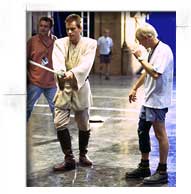
Nick Gillard: Ray Park is trained in Wu Shu And Long Fist. These are both non-weapon disciplines, so they had little influence on the lightsaber fights. July 2000
Doug Chiang: Not at all. We generally expect that 75 percent of the work that we do will not be used. Sometimes we grow fond of certain designs and are a little disappointed when those designs aren’t selected, but we are always reassured that only the best designs make it to the screen. Q : What are some of the most difficult things to reproduce realistically with digital animation and why?
Give me a good shot of seventeen Gungans tumbling down a hill at high speed with their arms and legs flailing any day! Tom Bertino was the Ground Battle Animation Supervisor on Episode I: The Phantom Menace. Prior to working on Star Wars, Tom supervised the animation on several films including The Mask(and was nominated for both an Academy Award and the British Academy Award), Casper, 101 Dalmatians, and was Animation Director/Visual Effects Supervisor for Flubber.
David Dozoretz: We are using Maya, which is a three-dimensional animation program by Alias Wavefront. We are using that primarily on Silicon Graphics work stations. We do a lot of our compositing — when we take all our different elements and put them together — in Adobe After Effects and Commotion on the Mac. We use Photoshop. We’re big Mac fans and SGI fans.
Doug Chiang: Episode II will be darker in tone and style. We will be playing with some interesting textures and lighting set-ups to heighten this darker mood. Beyond that, I cannot reveal any more. Q : Are Bail Antilles and Bail Organa supposed to be the same character?
Bail Antilles is also an Alderaanian politician. When Chancellor Valorum was ousted from office by a vote of no confidence, three nominees lined up to take his place: Ainlee Teem from Malastare, Palpatine from Naboo, and Bail Antilles from Alderaan. Although the scene was ultimately left out of the finished film, the script to Episode I shows that these two men were conceived of as separate characters. Both are mentioned. Bail Organa seconds the vote of no confidence; Bail Antilles is nominated to succeed Valorum. Two Bails, two different characters. It should be noted that “Antilles” is sort of the Star Wars equivalent of “Jones,” and “Smith.” There have been numerous characters throughout the films, books, and expanded universe material named Antilles, but almost none of them are directly related. For instance, Corellian hotshot starfighter pilot Wedge Antilles is not related to Bail Antilles. Nor is he related to C-3PO and R2-D2′s former master, Captain Antilles, the Rebel officer whom Vader chokes to death in the opening moments of A New Hope.
Nick Gillard: Sam is one of the nicest people on Earth, And yes, We talked about it a lot…
Ben Burtt: Mostly bears, with a dash of walrus, dog, and lion thrown in. Q : I’ve heard that Episode II will have even more computer effects than Episode I. How is that possible?
Since almost every shot in Episode I had some element of a digital effect, it won’t be more from a number of scenes standpoint. And since every element of the ground battle in The Phantom Menace involved the computer somehow, you can’t really top 100%. I think with Episode II, George has in mind to make the integration between live action and computer generated elements even tighter. There are some things that we’ve learned the computer can achieve for less money or with better creative result, and we’re going to try to exploit that even further. In some ways it will simply mean more realism or more lines for a CG character. George has also thrown down the gauntlet to ILM on a few tasks that no one has ever done with computer graphics before. It’s too early to talk about specifics, but if they can pull it off the results are going to be amazing.
David Dozoretz: Well, we’ve started and finished two major sequences for the film. But we’re far from done because it’s a Star Wars movie and there’s so much to do. Also, once principal photography has wrapped and the editing process begins, we’ll start another stage of animatics in which we combine animatics with the live action footage that George is shooting in Sydney.
Doug Chiang: Only in the morning before coffee Q : Will Mara Jade be in any of the prequels?
Q : How did you decide on the “personality” of the different engine sounds for each Podracer? What real-world noises did you use?
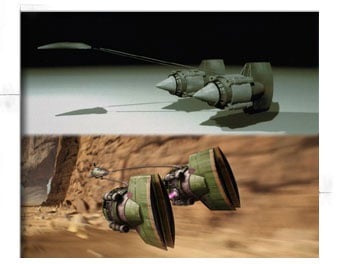
A pod sound can be powerful, angry, comical, smooth, cool, hip, old-fashioned, goofy, or dangerous. I try to make a sound that will relate to that type of coloration. Pod sounds were made from race cars, boats, warbirds, electric tooth brushes, shavers, motorcycles, rockets, and helicopters.
Nick Gillard: No, by that stage Ewan had become a very good fighter and learned the fight in around three hours.
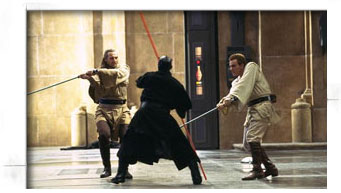
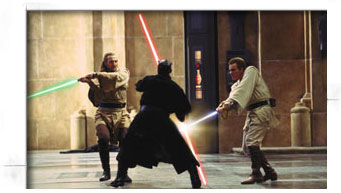
Q : How is the effect of extending a lightsaber done? Is the prop rod painted out until it’s extended?
The saber effect that is then created is a series of transparent colored layers which are painted underneath a white hot center core. This green, blue or red transparent glow and the white hot core is then applied to the area isolated by the matte. Then an overall soft white outer glow is applied. All layers flicker on and off and throw interactive light on the people, props and environment in the scene.
The lightsaber prop was completely painted out in some scenes, particularly in the more energetic duels since the prop stick was flexible and would bend when swung forcefully through the air. In other shots where the prop was not bowed, we were able to put the CG lightsaber directly over the prop.
Steve Sansweet: Let’s just say that this wasn’t the highest compliment in the galaxy. The quote is actually from The Empire Strikes Back, and in full, the lovely if hot-tempered Princess spit out, “Why, you stuck up…half-witted…scruffy-looking nerf-herder!”
Q : Is off-the-shelf software adequate for the work you do?
Q : Is it true that George Lucas has been consulting with some fans who have web sites to get help with writing Episode II?
George has a very clear vision about the story of Star Wars that he won’t allow to be swayed by the whims of the Internet, the media, critics or anyone. The Internet rumors this time around are possibly even more funny and off base than they were for the first film. Q : At what stage is your department’s concept design work for Episode II? Since filming is already underway, aren’t designs pretty much complete?
September 2000 Q : How much does the use of bluescreen affect the size and building process of the sets?
The bluescreen is just part of a process that we include in producing an environment that will work for the shoot. Whether you go back to the earlier days of matte paintings, scenic paintings or miniatures, it’s still the same process of trying to come up with a way that you can provide enough real backgrounds for the director to use, and then enhance that later. You make assumptions throughout the script developing process. By talking to John Knoll at ILM and George Lucas, Rick McCallum and Doug Chiang, you can come to some general conclusion about what is going to be best for that particular scene. And it’s different on every one; it’s always affected by the parameters of a scene and what’s required in it. For instance, how many shots there are: for a “one off” shot, one-shot scene or a two-shot scene, you could probably say that there’s less reason for us to build a full set. The cost is actually quite comparable for ILM to do it. Once you start having ten, twenty, or thirty shots in a scene in a set, then it becomes much more expensive for ILM to construct what we could really build more cheaply.
Ben Burtt: I prefer to record natural sounds as the basis for the audio in the Star Wars universe. Real “organic” sounds bring credibility with them. I try to create something that sounds “familiar” but unrecognizable. This gives the characters, vehicles, and objects the illusion of reality.
Nick Gillard: No–in fact, Ewan fought so fast that we considered slowing the film down. Q : Have you ever put any jokes or “easter eggs” in your animatics clips to see if George Lucas will notice?
One time, George was giving me direction on some computer generated robots for a shot and he was being very specific about their timing, movements, etc. So when I delivered the shot to him, at its end, I had the robots turn to camera and ask George “How was that take for you?” They then said they would be in their trailer. There are a few more like this, some much more funny, but you may see them someday, so I wouldn’t want to ruin the surprise now. Q : Hi there! I’m curious to know if there is a way to somehow learn more about Darth Maul as far as his species and anyone avenging his death?
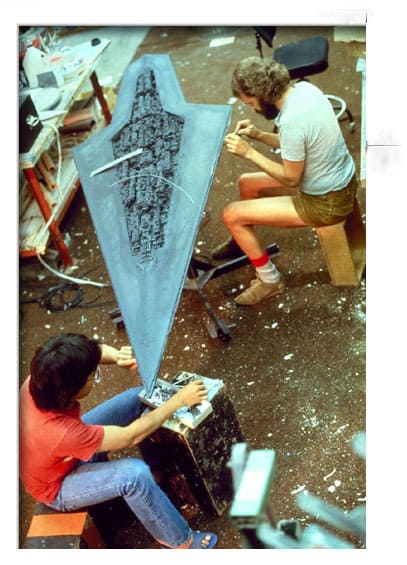
Q : How big was the Star Destroyer model used in the films?
Since the Star Destroyers had considerably more screen time in The Empire Strikes Back, they were completely rebuilt, including extensive interior and exterior detail and a lot more lighting; the size was increased to 8′ long. ILM also built detailed models of the conning towers (one was 4′ tall, another 10′ tall) and the ship’s “waistband”, originally 1 1/8″ was enlarged to 1′ 6″. These models were used in close-ups.
Darth Vader’s massive Super Star Destroyer model was slightly longer at 9.25 feet (282 cm). Lorne Peterson is one of the original members of Industrial Light & Magic, having been hired by George Lucas to create the models for Star Wars. In 1979, Peterson was invited by George Lucas to move to northern California to oversee the production of models for The Empire Strikes Back. Since that time, he has worked on most of Lucas’ films, as well as those of Steven Spielberg.
Doug Chiang: We will definitely try to incorporate some of the unused designs from Episode I into Episode II. However, since the story drives the designs, it will be difficult to incorporate ideas developed for a different storyline than Episode II. Q : Do you bother doing animatics for dialog sequences?
October 2000 Q : How did things go at the new studios? Did you miss Leavesden Studios in England at all?
Q : How long does the actual filming of a movie like the upcoming Episode II actually take? Is most of the time taken up by post-production, like special effects and editing, etc…?
So, out of the whole three year process (including a year of pre-production) we’re filming for only about 14 weeks or so. Q : The destroyer droids were very complex mechanically. How much of the ‘interworkings’ of the pieces were part of the concept phase?
Nick Gillard: The rumors are false. Ray didn’t join me on Episode II.
Q : Could you try to articulate the difference between special effects and visual effects?
Hanging miniatures are used to extend settings beyond what could be easily built, and involve careful positioning of detailed models that ‘hang’ down into a portion of the frame during a locked off (static camera) shot. Example: Ben Hur, Cleopatra, El Cid. Forced perspective sets allow the illusion of greater distance than the available space might permit, by tapering all constructed angles to diminish more rapidly than reality. This works as long as the camera doesn’t shift position to the right or left. Examples: Darby O’Gill and the Little People, Die Hard 2 (the airport set), and Howard the Duck.
Q : Are there any interns/apprentices on the concept team?
Nick Gillard: So far, Ewan has broken two of my fingers, I broke one of Hayden’s, and Sam Jackson hit me in the head, twice…
Gavin Bocquet: We actually built more sets, or parts of sets, for Episode II than we did for Episode I. On Episode I we had about 53 sets, whereas on Episode II we had about 67. Of these, probably 75% were new sets for Episode II. We probably had about 400 in the construction crew at the busiest time. Q : When creating engine sounds, such as the hyperdrive engine for the Queen’s ship or the submarine, do you base these sound designs in physics or simply come up with something that sounds ‘cool’?
November 2000 Q : Did George Lucas ever have any idea for Episodes VII to IX, or did the Star Wars novels stomp all over possible thoughts he may have had for the Star Wars universe past the destruction of the Empire?
LucasBooks has always checked with the boss to make sure that none of its projects interferes in any way with anything that he is planning. And while plans can change, rest assured that the wonderful expanded fictional universe enjoyed by so many fans has in no way stomped or trampled on any of George Lucas’s prerogatives or options.
Doug Chiang: I’m currently working on a personal book that will be published by Callaway Publishing in 2002. It’s an art book that I’ve been working on for years in my spare time. If you are interested in more information, please check out my personal web site at www.dchiang.com.
Doug Chiang: Absolutely. We often get totally immersed in the drawing. It’s not unusual to find us quietly making spaceship noises or creature growls or lightsaber sounds as we draw. The more we get into the “feel” of what we are drawing, the better the designs become. Plus, it’s just fun to imagine how these designs will move and sound.
Nick Gillard: Nitrogen flip-up rig — A device about the size of a set of bathroom scales. You stand on it, press a button, and 500 pounds of nitrogen is released. Blowing you into the air — marvelous feeling.
Gavin Bocquet: Yes, we certainly used some of the original props, like R2-D2 in Phantom, although they were modified because technology had improved. We also had some of the original lightsabers. We also used Luke’s original speeder as one of the speeders dressed in the Mos Espa streets location.
Q : Was the entire Gungan/Trade Federation battle sequence computer generated, or were some parts, like the grass, actually real?
During production, I supervised five other digital matte artists to ensure that the ground battle backgrounds looked similar to Doug Chiang’s concept drawings. We digitally painted a large part of the landscapes as well as augmenting and enhancing photographs of clouds. Many of the scenes were texture mapped and elements were composited in Saber. Our hope was that the final shots of the virtual Naboo landscapes looked like they could exist in our world, but they were really made up of many layers of digital elements.
December 2000 Q : With the advancements in special effects today and the use of computer generated actors, will there be a need for stunt men in the upcoming Star Wars films?
Q : Out of all the sets you supervised construction of for Episode I, which presented the greatest challenge?
Steve Sansweet: Physical feats and acts of strength aren’t always 100 percent repeatable. You may also ask why, if your favorite sports team defeated a rival once, do they not defeat them every time? Physical and mental exhaustion play a role in the use of Jedi powers. These may have hampered Obi-Wan’s abilities during the duel.
Doug Chiang: I would be thrown into the Sarlacc pit! Q : Did any animatics shot make it all the way through to the final film in Episode I?
|

 David Dozoretz: Kevin Baillie and Ryan Tudhope were “discovered” by the George Lucas Education Foundation. Their high school didn’t have a computer graphics program, so they made one of their own. The Foundation heard about it and introduced them to Rick McCallum, who introduced them to me. They’ve become an absolutely integral part of the team and will be with us through the production of Episode II. And, yes, there is hope for others to follow, if they put in a lot of hard work and have talent and the right attitude.
 Doug Chiang: Quite a lot. The majority of the research that we do when creating a design is to study the world around us. There are ideas everywhere, if you know what to look for and where. The inspirations can be as simple as a rusty door hinge or as obscure as dust mites. We always try to base our designs in reality to give them strong foundations. One of the dangers of designing alternate universes is creating something too fanciful and without a basis in reality. These designs often “date” very quickly.
 Q : What is the process of casting stunt people and extras?
 ILM: Motion capture is a technique for recording performances, like audio or video or film. Instead of recording images or sound, motion capture records the way a performer moves. The recorded performance can be applied to a computer generated character to make the character move the same way the performer moved.
 There a many ways to record motion. ILM uses a system that relies on reflective markers placed on the performer and many cameras surrounding the performance area. Each camera feeds its view of the performers into a computer which uses those views to calculate the position of each marker.
 Gavin Bocquet: These sort of decisions are always made collectively by a number of people. This would include George Lucas, Rick McCallum, the guys from ILM, Doug Chiang and myself. Every set or location had many different considerations, and it was always a fine balance between what we could achieve as a real set, from a visual, functional, and economic point of view, against how we could achieve those same results in the computer or with miniatures.
 Rick McCallum: Well there’s no conspiracy at work here, I assure you. It’s really about exploiting an exciting medium in the best possible way. George hopes to do something special with the DVD release but he isn’t available to work on it right now since we’re in pre-production on Episode II, with principal photography scheduled to begin this summer in Australia. Until George has some time to concentrate on it, we don’t anticipate releasing any of the Star Wars movies on DVD in the foreseeable future.
 Steve Sansweet: Well, as we know, Obi-Wan Kenobi disappears when he was struck down by Darth Vader in the original Star Wars: Episode IV A New Hope, after telling the evil Sith Lord, “If you strike me down, I shall become more powerful that you can possibly imagine.” When Yoda dies, he fades away. And when Darth Vader sacrifices himself in the end to save his son, he too becomes one with the Force (it is his armor that burned in the Endor funeral pyre).
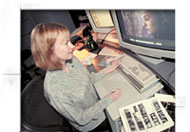 Rita Zimmerman was a Sabre Artist on The Phantom Menace. She worked on the space battles, Coruscant city sequences as well as saber battle scenes. She also did many shots for Star Wars Special Edition.
 Nerfs, like certain hotshot pilots, are temperamental and cantankerous. The comparison stops there, however. These domesticated herb-eaters are raised for their delicious meat. That’s a good thing because they have one of the most foul odors this side of the Galactic Core. The rangy, supple creatures have long fur covering their muscular bodies and dull, curved horns. They also tend to spit at their handlers, which probably doesn’t work wonders for the dispositions of the nerf herders either.

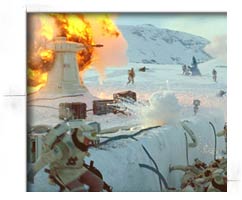 Rear projection involves projecting either a still or moving picture onto the rear of a translucent screen in front of which live-action is photographed so that both the background on the screen and foreground action are combined into a single image on the exposed film. Examples: almost any time you see a car interior with the street scene passing by out the rear window (as in Hitchcock’s Notorious) or western landscape rolling by in the old cowboy movies.
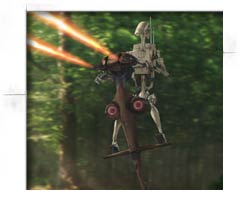 Visual effects, on the other hand, are added after the scene has been shot, and range from simple double exposure tricks (where the film is partially exposed with a ‘latent image’ and later, further exposed with added elements) to motion control miniatures (shot with long exposures for depth of field focus against a blue screen) and other blue, green, or black screen elements (people, explosions, smoke, flying debris) which are later composited with the original plate photography. The removal (and alteration) of unwanted rigging, reflections, and other two dimensional ‘fixes’ such as joining together two different actions in the same shot is another common visual trick (as the two different McFlys played by Michael J. Fox in the Back to the Future films). More recently, the creation and addition of entirely synthetic animated characters, settings and environments has become the most publicized part of the visual effects industry, and appear in some form in almost every major film we see today, even if limited to a few digital matte paintings to set the scene.
 Jeff Olson joined ILM in 1985 as set builder and modelmaker on Howard the Duck. Olson became manager of ILM’s model/creature department in 1993 and then transitioned into visual effects production in 1996. He was one of the visual effects producers for Star Wars: Episode I The Phantom Menace.
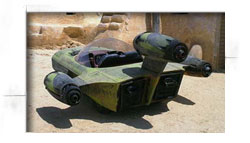
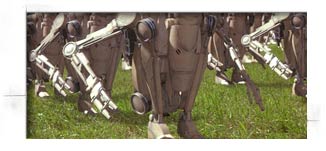
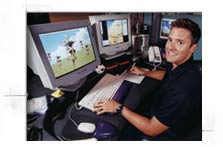 Ronn Brown was Digital Matte Supervisor for the Ground Battle Sequence on Star Wars: Episode I The Phantom Menace. He joined ILM in 1993 and has worked on several groundbreaking films including Space Cowboys, Star Wars Special Edition, Galaxy Quest, Men in Black and Mars Attacks!
 Nick Gillard: I had to develop a new terminology for lightsaber fights, as they incorporate so many different styles. There are twelve basic moves. As for posting a section of the script, unfortunately I am bound by a confidentiality agreement…


Please Share this post:
- Share on X (Opens in new window) X
- Share on Tumblr (Opens in new window) Tumblr
- Share on Mastodon (Opens in new window) Mastodon
- Share on Bluesky (Opens in new window) Bluesky
- Share on Facebook (Opens in new window) Facebook
- Print (Opens in new window) Print
- More
- Email a link to a friend (Opens in new window) Email
- Share on Threads (Opens in new window) Threads
- Share on Reddit (Opens in new window) Reddit
- Share on Pinterest (Opens in new window) Pinterest
- Share on LinkedIn (Opens in new window) LinkedIn
- Share on WhatsApp (Opens in new window) WhatsApp
- Share on Nextdoor (Opens in new window) Nextdoor
- Share on Telegram (Opens in new window) Telegram