
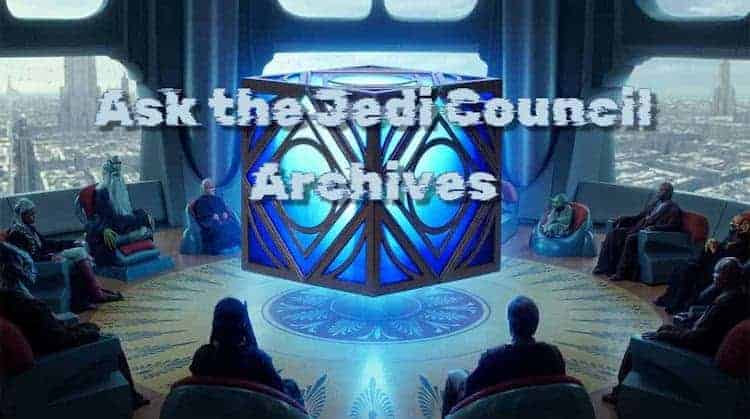
Step Into 2003 — The Jedi Council Is In Session
Welcome to the Ask the Lucasfilm Jedi Council Archives. A feature of *starwars.com no longer directly available. This is not a complete archive in regards to images and such but I have salvaged everything else that I was able to and can now say I have found ALL of the questions that were asked of the esteemed council!!. 
(*Archived here with Permission utilising The Internet Archive Wayback Machine)
Ask the Jedi Council Archives – 2003 compiles Lucasfilm’s official Q&A responses from 2003, a year shaped by the production momentum of Episode III and the evolving arcs of Anakin, Obi‑Wan, and the Jedi Order. The material blends lore clarifications, behind‑the‑scenes filmmaking insights, and technology‑focused explanations as Lucasfilm addressed fan questions during a period of rapid digital innovation. These exchanges reveal how the studio communicated about character development, continuity, visual effects, and the shifting Jedi mythology leading into the final chapter of the prequel trilogy. It’s a preserved snapshot of early‑2000s Lucasfilm thinking at a pivotal moment in the saga’s creation.


Q : Who will be joining the cast for Episode III?
Basically everything’s been cast except for incidental characters. That obviously won’t begin until we’re further along on the script.
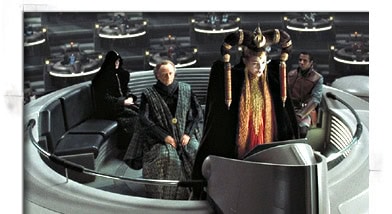
Jocasta Nu: Look closer, young Padawan. It is actually Queen Amidala’s handmaidens, Eirtaé and Rabé, who accompany her to the Senate hall wearing those dark cloaks.
February 2003
Jocasta Nu: Actually, Obi-Wan said Anakin was “already a great pilot” when they met, which he was as witnessed in the Boonta Eve Podrace. It was on Tatooine that Obi-Wan told Luke that Anakin was “the best star-pilot in the galaxy,” a trait that Anakin would develop sometime after his meeting with Kenobi. Q : At the beginning of A New Hope, Threepio knows about the Princess. Then when he is on Tatooine and Luke asks who she is, Threepio doesn’t know. Did he do this on purpose?
Princess Leia also commanded R2-D2 under this protocol to deliver the Death Star plans to Obi-Wan Kenobi at all costs. March 2003
Jocasta Nu: Coleman Trebor is a Vurk. Sar Labooda is a humanoid female with dark hair. She does not have a “dinosaur head” and never did. It would seem your data is in error.
Jocasta Nu: Yes, the Far Outsiders were indeed an advance party of Yuuzhan Vong invaders.
Steve Sansweet: For the definitive answer, we turn to none other than George Lucas himself. Here’s what he had to say: “I think of the series as one movie. In order to keep the impact of the hyperspace jump in Episode IV, I have decided not to use it in the first three films. If you’re watching them from one to six, you’ll get the same thrill.” Q : How are the locations for the Star Wars Celebrations chosen? How can I get my city on the “list?”
We look for a city with a large and convenient convention center or similar facility, reasonably-priced hotels nearby, as centrally located or as easily reachable by air and car as possible, used to entertaining big crowds (we topped out at around 27,000 people last year), and friendly. We’ve been approached with a lot of suggestions for Star Wars Celebration III, and we hope to be able to settle on a location no later than this summer. You’ll read the first official word here at starwars.com.
Rob Coleman’s Answer: I have already begun working part-time on the film. Right now, we are in the pre-production planning phase. Myself and visual effects supervisors John Knoll, Pablo Helman and Ben Snow have been shown the amazing artwork and designs coming out of the Art Department. We have started to discuss how we are going to approach the visual effects and animation work. Just this week, I was looking at which character models we could start building.
At ILM, Coleman has focused his efforts on the combination of live action and animated characters. He is especially interested in raising the quality and acting performance of the digital creatures, and works to help ILM’s animators understand that they are actors too. Coleman recently directed the animation for Star Wars: Episode II Attack of the Clones, which featured 70 minutes of animation including the new digitally animated version of the legendary Yoda character. Coleman has been nominated for two BAFTAs for his work on Men In Black and Star Wars: Episode I The Phantom Menace, an Academy Award nomination for his work on The Phantom Menace, and most recently an Academy Award nomination for his work on Star Wars: Episode II Attack of the Clones. Q : Since Episode III is the last episode, what happens to all the sets once you’re finished?
However, Star Wars is a little different than other films and certain pieces from the shoot are kept and stored at the archive at Lucasfilm. Usually this will include any smaller and interesting set pieces, usually things like speeders or starfighters, if they are not too big. If they can fit into a shipping container then Rick McCallum and George Lucas will discuss whether a certain piece is worth keeping. But in general most ‘sets’ are not kept. The largest pieces we have kept so far are a full-size Naboo starfighter from Episode I, and a full-size Jedi starfighter from Episode II. A lot more of the props and set dressing will be kept, as well as the costumes, since they are smaller in volume and therefore much more easy to store and transport.
Jocasta Nu: Your eyes are deceiving you, young Padawan. The figure in question is clearly part of the Neimoidian ground crew, and in no way connected to the future Dark Lord. Q : The Return of the Jedi credits list a character named Nicki. Who is Nicki?
April 2003 Q : Since you started way back in Episode I, have there been any new building materials or processes developed that makes your job easier?
The film business is, by its nature, a low-volume production business, and therefore we are not able to make use of techniques normally used in industry. If we were making 1,000 of the same object, then we could use these pieces of equipment, but we are more craft-orientated than mass production-orientated, with the need to make only small numbers of any given object. The world of CAD drawing in the Art Department had seen a big advancement over the last 10 years, and this has a direct input into the Construction Department, as we can often feed the CAD information directly into various machine tools, like the router, or 5-axis cutter, which will cut shapes and elements straight from the digital information out of a variety of materials. Q : Are there any plans for adapting Episodes I and/or II into radio plays? I quite enjoyed the adaptations of the original trilogy.
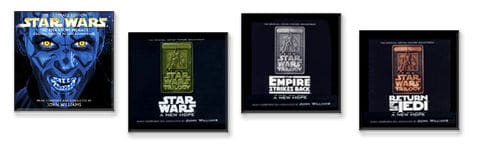
A New Hope NPR Radio Dramas Manufacturer: Highbridge Creative Team: Description:
The series contains a greatly expanded version of Part IV of the saga, Star Wars: A New Hope , with characters and episodes not seen in the films, all combined with Oscar-winning movie music and sound effects. The Empire Strikes Back NPR Radio Dramas Manufacturer: Highbridge Creative Team: Description:
The series contains a greatly expanded version of Part V of the saga, Star Wars: The Empire Strikes Back , with characters and episodes not seen in the films, all combined with Oscar-winning movie music and sound effects. Return of the Jedi Radio Drama Manufacturer: Highbridge Creative Team: Description:
As for adapting, airing, and making available dramatizations of the Star Wars prequels, that is something that Lucasfilm has looked into over the past few years. But it is a very complicated business, creative and personnel process to get all of the planets to line up just right. So while it is accurate to say we remain interested in such a project, there is nothing currently on the schedule or close to happening. If that changes, you’ll get the news here first.
Ben Burtt: That was James Earl Jones. The line was recorded for A New Hope but never used. Q : Is there any chance that you or Mr. Lucas will make a cameo appearance in Episode III?
Besides, it might ruin the continuity of my masterful Episode I performance. George isn’t interested in being in front of the camera, but you never know. Q : What do I do with the Jedi Master Points on toy packaging?
Actually, the question of what to do with these little rectangles on the back of Hasbro’s figures and other Star Wars toy packaging is probably the single most-asked question sent to Star Wars Insider‘s “Scouting the Galaxy” column — and also to Hasbro. And the answer is that Hasbro, after working through many business and legal issues, has made much progress in coming up with a cool answer of what to do with Jedi Master Points. “It has taken longer than we would have liked,” notes Jeff Popper, Hasbro’s director of marketing for Star Wars. Hasbro is hoping to be able to announce its plans in the not too-distant future, once every element is worked out. My advice: round up as many of those ubiquitous Points as you can, and stay tuned! Q : How did you decide to give Zam Wesell’s speeder that howl? Is it based on its look? Where did that sound come from?
Q : How big (file size and pixel dimensions) was the biggest matte painting done for Episode I or II?
The real space-consuming part of the shot came from the source files used to model and render the comp. Including scene files, models, textures, render passes, and final comp, this shot probably consumed 80-90 gigabytes of space until the shot was a final. Jonathan Harb joined Industrial Light & Magic in 1996 as a technical assistant in the art department. In 1998, Harb moved on to the Digital Matte Department and has most recently taken on the supervision for the group. Harb graduated Summa Cum Laude from the School of Design at North Carolina State University, earning a Bachelor’s degree of Environmental Design in Industrial Design. As a supervisor among matte artists, his responsibilities include shot production, supervision of ongoing shows for the matte group, as well as sourcing and hiring top-level digital matte artists. His feature film credits as Lead Digital Matte Artist include The Pirates of the Caribbean, Van Helsing, and Star Wars: Episode II Attack of the Clones. His credits as Digital Matte Artist include Hulk, Men In Black II, A.I. — Artificial Intelligence, The Perfect Storm, Sleepy Hollow, and Star Wars: Episode I The Phantom Menace. Q : Will virtual sets ever put Production Designers out of work?
May 2003
Jocasta Nu: No, of course not. Q : I was wondering if you knew when an Ultimate Edition of the Attack of the Clones soundtrack will be released. I love the two-disc sets for the other four films.
Ryan Church: To some extent it will. There are certain cultures and technologies in this new movie that will reflect the 1970s look. It’s going to be a subtle thing, but it will make sense when you see it. To us in the Art Department the ‘1970s look’ is actually just the look of the Star Wars universe during its dark ages rather than the waning glory days portrayed in the prequels. Q : What home learning path would you recommend for studying animatics. Any off-the-shelf software and hardware recommendations?
For a learning path — just do it. By that, I mean the only way you’re going to learn these tools is by using them and putting your absolute heart into them. Learn by doing. Spend the the time it takes to really learn how everything works and you will find the path. Of course, traditional art skills are absolutely essential as well. Draw, draw, draw and learn about all kinds of art!
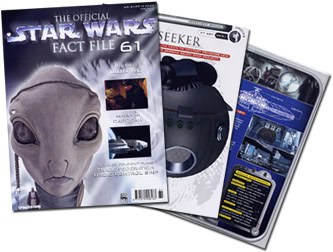
Steve Sansweet: The Official Star Wars Fact File from DeAgostini has been very popular in numerous languages around the world, including Japanese, Spanish, French, German, and of course, English. It is a weekly publication that includes sections on battles and events, characters, weapons and technology, planets and locations, droids, and vehicles. Each issue is meant to be pulled apart and then filed in a different order in large binders that occasionally come with that week’s Fact File.
While LucasBooks is aware that many American fans would enjoy Fact File, the U.S. also has the most robust Star Wars publishing program in the world. Ballantine Books/Del Rey publishes a wonderful series of Essential Guides, for example. So there is some concern about overloading the market. While there are no current plans to bring Fact File to the U.S., this is one of those things that is constantly evaluated. Q : With a film camera, you have to shoot a specific speed to make miniatures look real. How did you do this with a digital camera that only shoots 24 frames per second?
Most of the models in Episode II were shot digitally on a motion control system. In a film camera, the shutter is only open half of the time. The other half, while the shutter is closed, the film is being moved to the next frame. Since the digital camera doesn’t need to do this, it’s possible to have the shutter open essentially all of the time. We wrote some software that then lets us average some arbitrary number of frames to synthetically create longer exposures. For example, to simulate one-second exposures, we average 24 frames. This technique was used throughout the film. The other case we frequently have to deal with is when we run the camera faster than 24 frames per second, like when shooting explosions. There was very little call for that on Episode II, since the explosions were done using CG techniques. If we really need to shoot a high-speed explosion, we have to do it on film. Perhaps someday we’ll have digital cameras that can run at 300 frames per second, but we don’t have them yet. John Knoll brings unique expertise and innovation in computer graphics to the creation of visual effects. Knoll and his brother are the original creators of Photoshop, a high-end digital image-processing program. Knoll was also the Computer Graphics Project Designer on The Abyss, for which ILM was honored with its tenth Academy Award for Best Visual Effects. His credits as Visual Effects Supervisor include Star Wars: Episode II Attack of the Clones, Pirates of the Caribbean, Mission to Mars, Deep Blue Sea, Star Wars: Episode I The Phantom Menace, Star Trek: First Contact, The Star Wars Trilogy: Special Edition, and Mission: Impossible.
Gavin Bocquet: Very few ceilings are ever built on a film set, unless the set is very small, like Anakin’s Slave Quarters on Episode I. We also built ceilings for Watto’s Shop and the interior of Padmé’s Naboo Royal Starship on Episode I , and the starfreigher hold and Padmé’s Naboo starship on Episode II. You may build part of a ceiling, when the camera is seeing off the top of a bigger set. Even in this age of digital enhancement, it can still be cheaper to build a small piece of ceiling, than to add it digitally. One key reason for not building ceilings on film sets is the need for the Lighting Cameraman to be able to light through that space from above, as opposed to the restriction found on a location. So even before the digital world existed, ceilings were generally not built, and were added by matte paintings, glass paintings, or foreground miniatures. On Gone with the Wind, all the grand ceilings you see were painted by a matte artist, either on glass in front of the camera, or in postproduction.
Ryan Church: I hope that there will be other outlets for the creativity and inspiration of the Art Department. I’m personally hoping that there’s some way, through books or DVD or exhibits, for the fans to see the incredible amount of work and creativity that goes with making a movie like this. George Lucas is unlike any other when it comes to archiving and preserving the props and artwork of his films; he really loves this stuff. June 2003 Q: In Return of the Jedi, who are the gentlemen that exit the shuttle with Emperor Palpatine?
Among the members of Palpatine’s Inner Circle are: Sate Pestage, Janus Greejatus, Sim Aloo, Ars Dangor, and Kren Blista-Vanee.
Ben Burtt: My favorite sound is the “Robin Hood Arrow” from the 1938 Adventures of Robin Hood. I have many favorites. I could write a book on the ones I love and their stories. Q: In the original trilogy, Coruscant was not mentioned. But it appeared in the videogame Dark Forces and elsewhere. Was Coruscant invented by George Lucas?
In these early drafts, the planet was called Had Abbadon. The name Coruscant came from author Timothy Zahn for his 1991 novel, Heir to the Empire. It’s actually a real word that means “glittering” or “giving forth flashes of light.” When it came time to name the city-planet for Episode I, after considering several other names, Lucas decided to go with the already established Coruscant. Q: How do you show your stuff to George Lucas? Does he watch QuickTime videos on your monitors or do you project it in a theater?
Q: On the Episode II DVD, there are animatics of other tank droids and clone troopers on speeder bikes. How far did those sequences get. Were there CG models made of them?
Raised in rural Australia, Ben Snow studied computing and film at the University of Canberra. He did a variety of work and traveled extensively before working as a runner for a computer graphics house in London. Snow later returned to Australia to set up the computer animation department for a company in Sydney. There he worked on commercials, broadcast idents and openers, including a CG title sequence for Beyond 2000. Snow left Australia to join Industrial Light & Magic in 1994, where his first project was to help create the three dimensional computer graphics image of the “Enterprise B” for Star Trek: Generations. This version had to intercut seamlessly with the motion control model shot on ILM’s soundstage, one of the first such endeavors for a feature film. In addition to his feature credits, Snow has been instrumental in the research and development required for the groundbreaking images seen in Twister, Deep Impact and Pearl Harbor. His work on Star Wars: Episode II Attack of the Clones received an Academy Award nomination for best visual effects. Snow is currently working on Van Helsing. Q: Are any unused designs from the previous Episodes going to appear in Episode III?
Ben Burtt: George Lucas made that decision. He was trying to reduce the contentiousness between the two Jedi at a tense moment when they were supposed to be chasing Zam rather than having a personal moment. July 2003 Q: What is Palpatine’s first name?
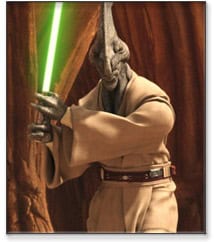
Q: What’s the name of the Nikto Jedi Knight seen in the Geonosis Arena?
Q: Although it was probably accidental, were you worried about the similarities between the Kaminoans and the A.I. aliens?
At ILM, Coleman has focused his efforts on the combination of live action and animated characters. He is especially interested in raising the quality and acting performance of the digital creatures, and works to help ILM’s animators understand that they are actors too. Coleman recently directed the animation for Star Wars: Episode II Attack of the Clones, which featured 70 minutes of animation including the new digitally animated version of the legendary Yoda character. Coleman has been nominated for two BAFTAs for his work on Men In Black and Star Wars: Episode I The Phantom Menace, an Academy Award nomination for his work on The Phantom Menace, and most recently an Academy Award nomination for his work on Star Wars: Episode II Attack of the Clones. Q: What is your favorite Star Wars set that you worked on, or one that you didn’t work on?
In then end, I think everybody has always felt very strongly about the whole of the Tatooine world, and I am no different in that respect. There is such a strong connection to the original films in Tunisia/Tatooine, that when we went back there for Episodes I and II, we all felt as though we were involved in a bit of film history. So having to reproduce the Lars Homestead for Episode II, and also create Mos Espa and its Slave Quarters for Episode I, as well as a lot of the Podrace scenes, was very exciting and challenging. So all things considered, I feel that the whole Tatooine experience for us on Episodes I and II, was certainly one of our favorite experiences. Q: I’d like to get the Star Wars Insider, but it says I can’t get it in my country. Is there anything else I can do?
Q: For animatics, how detailed did you animate big crowds like the battle droids and clone forces?
Ben Burtt: The music in Episode II ended differently than in Episode I, and the juxtoposition of breathing seemed improper for the mood.
Jocasta Nu: Both Viceroy Nute Gunray and Lott Dod did indeed escape Geonosis. Q: In what ways will Episode III resemble Episodes I and II, and Episodes IV-VI?
Ben Burtt: That sound is boiling liquid nitogen recorded in my father’s chemistry lab. August 2003 Q: What computer tools do you use in your department?
We have draughtspeople using CAD with both Autocad and Vectorworks. We also have concept designers working on a variety of 3-D programs including Lightwave, 3-D Studio Max, Rhino, and 2-D programs like Painter. We have graphic designers working on Photoshop and Illustrator. We also do a lot of organizational work, like schedules and budgets on spreadsheet programs like Excel and FileMaker Pro. There are no rules as to what are the correct programs to use. Each individual uses the programs they feel most comfortable with for the work they are doing, and for the education and experience they have had. Q: How many minutes worth of material did your team generate when figuring out the Clone Wars?
Q: Does George Lucas read the starwars.com message boards?
Q: What innovation would make your job easier?
Way faster computers. Computers are never fast enough. The key to getting the best results is iterative refinement. You look at a shot, make a list of improvements you’d like to make, work on those, run the shot again, and repeat. You keep doing that until the shot’s perfect or you run out of time, and the faster you can see the results of a change, the more iterations you can get in before you run out of time. Unfortunately, computers do get faster all the time, and we respond to that by doing harder shots with them until the render times get to be unbearable again, thereby lengthing the iteration time. What we need are computers so fast, we can’t make the shots complex enough to slow them down…
Ben Burtt: The smell of workprint and the 35mm magnetic film stock. It used to be the sweet ambiance of the cutting room. It probably wasn’t healthy but it added to the charm of the work. Q: Do you use any of the Star Wars books and guides when working on your designs? Do you look at the “Expanded Universe” at all?
For Episode III we’re going to a lot of new places and George Lucas has really pushed us to come up with new looks for vehicles, environments, cultures and characters. When we receive an assignment that deals with an aspect of the Star Wars universe that hasn’t been nailed down in the movies, George likes us to keep a completely open mind and leave behind our preconceived notions or expectations for that culture or character. That freedom, coupled with the fact that we are such fans of the movies, can lead to some very interesting solutions. The biggest single source of inspiration, though, are the movies themselves. We design for the that medium, for how things will look up on the screen, as part of the story. Q: Is ILM able to use any of the digital models and animation that animatics create? Or vice-versa? Or do you each develop from scratch?
Ryan Church: Yes, that’s a very cool part that happens after the movie comes out, to see the toys and video games that use those designs and allows them to exist a little more. As a designer there’s nothing quite like holding a model of your design. It’s very cool. September 2003
Ben Burtt: That is an old body fall effect used in many movies since the 1940s. You can hear it in some Bogart films like Passage To Marseille and many westerns. Q: Nowadays, is there any real reason to use blue or green as the color of a background? Could you just as easily have orange-screens or red-screens?
The main reason we still use blue and green is that those colors have the greatest contrast with skin tones and most of the wardrobe we need to shoot in front of those screens (think of the Jedi robes, for example). The way blue and greenscreens work is that the computer looks for differences in color between the foreground and background. Since skin tones have a lot of red in them, if we shot redscreen, it would be much harder for the computer to tell what was skin and what was the screen. That said, we also have to work with objects that are blue or green, so we alternate between blue and green depending on what’s in the foreground. For example, we shoot R2-D2 in front of a greenscreen because of his blue panels. Sometimes George puts blue and green stuff in a shot, and we have to decide which is most important to choose the screen color. Objects that are the same color as the screen can’t be extracted automatically, and have to be hand-rotoscoped.
Q: What does one need to study to become a Production Designer?
Other people may decide to do a general art and design course first, maybe looking at Graphics, Architecture, Product or other areas, and then decide to specialize in Production Design at a later stage. Again, depending on what country you are based, you can find graduate courses that specialize in Production Design for people who have already done preliminary courses in other areas of design. In general, there are quite a few ways to proceed if you want to become a Production Designer, but initally, doing an art and design course of some sort, is a good way to start. Q:What software has been used for animatics in Episode II?
Q:Are animators assigned characters, or are they assigned sequences, and how is that decided?
Lead animators are assigned to one character or a few characters, the leads then supervise a team of animators working with them on a sequence. Animators are “cast” depending on their strengths. Some animators are better at quiet acting moments while others are best suited to huge action sequences. An animator may work on a variety of characters with a number of lead animators over the production of the film.
At ILM, Coleman has focused his efforts on the combination of live action and animated characters. He is especially interested in raising the quality and acting performance of the digital creatures, and works to help ILM’s animators understand that they are actors too. Coleman recently directed the animation for Star Wars: Episode II Attack of the Clones, which featured 70 minutes of animation including the new digitally animated version of the legendary Yoda character. Coleman has been nominated for two BAFTAs for his work on Men In Black and Star Wars: Episode I The Phantom Menace, an Academy Award nomination for his work on The Phantom Menace, and most recently an Academy Award nomination for his work on Star Wars: Episode II Attack of the Clones.
Ben Burtt: Some dolphins and pigs were used, but actually a main component for both the acklay and the reek were made by dragging a huge wooden palette across the sound stage floor in Sydney. Q: Is there really a shaak in the Episode II asteroid field? Where is it?
Yes, it’s in there. It’s got the asteroid shader on it, so it’s covered with craters and looks like all of the other asteroids. It’s visible at the second “seismic charge” blast. If you look just to the lower right of the flash, at about 5 o’clock, there’s a rounded object that is the shaak. You might be able to make out the legs and snout if you look carefully. Another fun thing is that in the next shot after that, the big asteroid that’s being shattered is Eros. While we were working on that scene, NASA was conducting a rendevous between the asteroid Eros and the NEAR Shoemaker space probe. They were returning great photos of it that we were studying, and they ultimately soft landed the probe on Eros where it rests today. Part of the data that was collected during the mission was a 3-D topographic map of the entire surface of Eros. I contacted one of the mission scientests at NASA, Gregory Shirah, asking if I could get a copy of the data set to use in the movie. He agreed, and that’s the asteroid we shattered in that shot. John Knoll brings unique expertise and innovation in computer graphics to the creation of visual effects. Knoll and his brother are the original creators of Photoshop, a high-end digital image-processing program. Knoll was also the Computer Graphics Project Designer on The Abyss, for which ILM was honored with its tenth Academy Award for Best Visual Effects. His credits as Visual Effects Supervisor include Star Wars: Episode II Attack of the Clones, Pirates of the Caribbean, Mission to Mars, Deep Blue Sea, Star Wars: Episode I The Phantom Menace, Star Trek: First Contact, The Star Wars Trilogy: Special Edition, and Mission: Impossible.
Ben Burtt: I think I can enjoy it just as a movie unless I know the person who did the sound, then I am often aware of the work unless it is truly a superior film and I am completely drawn in. November Q: When will fans around the world be able to see a glimpse of your incredible collection?
Frankly, I’ve been holding off until it was in pretty good shape so I could show my fellow fans in the pages of Star Wars Insider and any of the other international licensed fan magazines that are interested. That story just ran in Insider #71, in an issue focusing on Star Wars collecting and collectibles. Building my personal Star Wars collection has been a labor of love for 26 years, and I finally have a place to display it all. But as I always say — and truly mean — it has been the experience of collecting and the worldwide friendships that I have developed that are the most important things that have come out of my passion for all things Star Wars. Q: Could you possibly supply us with a picture of Ian McDiarmid (sans makeup), when he shot Return of the Jedi? I don’t believe he was so young.
Makeup sessions initially took four hours a day, although with practice that eventually was reduced to two and a half hours. In an interview with Star Wars Insider two years ago, McDiarmid had just re-watched a video of himself in Jedi and said he couldn’t help but think, “Oh God, there’s such a young person underneath all that.” In Episode I, Senator Palpatine had fairly standard makeup. In Episode II, he had aged somewhat. We all await his final look — and what it portends — in Episode III. December 2003
Nick Gillard: I think after Episode III, it will be Hayden Christensen. Q: What can be done to encourage stores to stock their shelves with new Star Wars materials? I keep finding the same old stuff every time I go!
And the key word is “shipping,” because once Star Wars toys and other products leave the warehouses of Hasbro and other licensees, they take different kinds of paths to the shelves, determined by individual retailers. Some are amazingly quick, and don’t like items sitting on their shelves for more than a few weeks; other are frustratingly slow and have year-old stock clogging the pegs constantly. Manufacturers try to deal with that sometimes by changing out old stock, or encouraging sales. What to do? You can go to the managers of your favorite stores and tell them you’d be spending a lot more on Star Wars if they only had the latest items in their stores, just like their competitors a state away, as shown by a report on your favorite web site.
Nick Gillard: No, George Lucas had a very clear ideas of how he wanted the evolution to look. |

 Rick McCallum: Look for most of the actors from Episode II to return with the story focusing on the characters played by Hayden Christensen (Anakin), Ewan McGregor (Obi-Wan), Natalie Portman (Padmé) and Ian McDiarmid (Palpatine).
 Q : Who is the cloaked character sitting in the back of the Naboo Senate box in Episode I that seems to look like Darth Sidious?
 Q : Why haven’t we seen the stars stretch into lines when a ship jumps to hyperspace in the prequel trilogy?
 Q : When does ILM start its work on Episode III, or has it already?
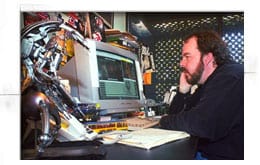 Rob Coleman joined Industrial Light & Magic’s team of animators in 1993 to work on The Mask. Prior to ILM, Coleman received his Bachelor of Fine Arts degree from the classical film animation program at Concordia University in Montreal, Quebec, Canada in 1987. After graduation he worked in Toronto, at the National Film Board of Canada and at a number of small animation studios.
 Gavin Bocquet: Most of the large set pieces will be destroyed, as they have been on Episode I and on Episode II, and as they are on all other films. Most film sets are not built to last more than a couple of months, as this would add a great deal to the budget, so there would be no point in keeping them.
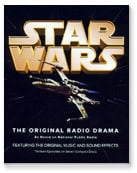 In March 1981, the first of thirteen half-hour Star Wars radio programs produced by KUSC-FM in Los Angeles and National Public Radio were aired on public radio. The results were phenomenal generating 50,000 letters and phone calls in a single week, 750,000 listeners per episode and a 40% jump in the overall NPR audience. Star Wars was later rebroadcast in late 1982 and followed by ten half-hour The Empire Strikes Back radio programs which began initial broadcast in February 1983.
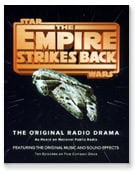 In March 1981, the first of thirteen half-hour Star Wars radio programs produced by KUSC-FM in Los Angeles and National Public Radio were aired on public radio. The results were phenomenal generating 50,000 letters and phone calls in a single week, 750,000 listeners per episode and a 40% jump in the overall NPR audience. Star Wars was later rebroadcast in late 1982 and followed by ten half-hour The Empire Strikes Back radio programs which began initial broadcast in February 1983.
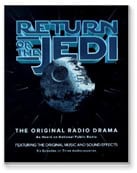 A newly created full-cast audio dramatization written by Brian Daley and produced by HighBridge, this program contains new action scenes and additional dialogue.
 Q : Who’s voice was used for Darth Vader in the Special Edition of The Empire Strikes Back? I’m talking about the part when he says “Alert my Star Destroyer to prepare for my arrival.”
 Q : Will Episode III look like it will lead into the 1970s, so it matches up with Episode IV?
 Dan Gregoire: The great thing about our department and technology today is we can use all off-the-shelf software and hardware. With After Effects, Maya and a PC, we can totally do our jobs. Each of our artists has a Macintosh on one side and an AMD-based PC workstation from Boxx Technologies on the other. All these tools are available to anyone.
 John Knoll’s Answer:
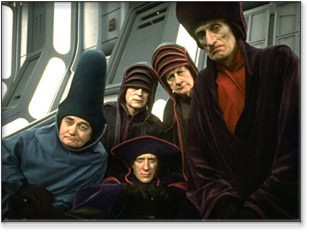
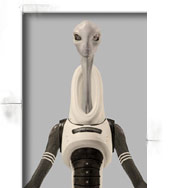 The design similarities between the Kaminoans and the A.I. aliens (which were actually robots) were coincidental. I believe that George Lucas was trying to evoke the idea of the classic almond shaped alien. A.I wasn’t our concern, but Jedi Master Yarael Poof, a long necked Jedi seen on the Jedi Council in The Phantom Menace, was. He was removed in Attack of the Clones and replaced with Jedi Master Coleman Trebor so there wasn’t any confusion that a Kaminoan was on the Jedi Council.
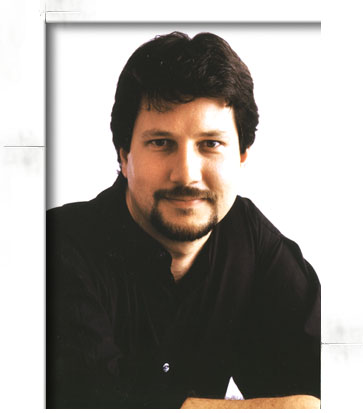
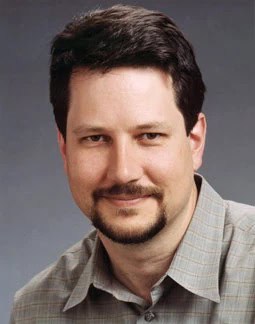 John Knoll brings unique expertise and innovation in computer graphics to the creation of visual effects. Knoll and his brother are the original creators of Photoshop, a high-end digital image-processing program. Knoll was also the Computer Graphics Project Designer on The Abyss, for which ILM was honored with its tenth Academy Award for Best Visual Effects. His credits as Visual Effects Supervisor include Star Wars: Episode II Attack of the Clones, Pirates of the Caribbean, Mission to Mars, Deep Blue Sea, Star Wars: Episode I The Phantom Menace, Star Trek: First Contact, The Star Wars Trilogy: Special Edition, and Mission: Impossible.
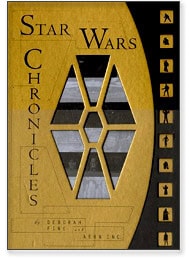 Cross-Section books provide a great starting point when we’re adding to existing locations. We usually don’t refer to the Expanded Universe materials specifically unless our research team finds something that directly corresponds to our assignment.
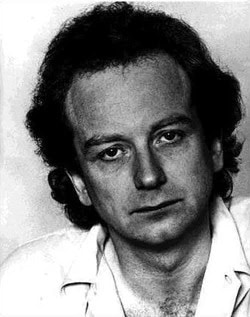 of his prominent nose. McDiarmid had a full mane of light brown hair — not that you could see it or any of his other actual features.
 Q: Who do you think has been Hollywood’s best swordsman?


Please Share this post:
- Share on X (Opens in new window) X
- Share on Tumblr (Opens in new window) Tumblr
- Share on Mastodon (Opens in new window) Mastodon
- Share on Bluesky (Opens in new window) Bluesky
- Share on Facebook (Opens in new window) Facebook
- Print (Opens in new window) Print
- More
- Email a link to a friend (Opens in new window) Email
- Share on Threads (Opens in new window) Threads
- Share on Reddit (Opens in new window) Reddit
- Share on Pinterest (Opens in new window) Pinterest
- Share on LinkedIn (Opens in new window) LinkedIn
- Share on WhatsApp (Opens in new window) WhatsApp
- Share on Nextdoor (Opens in new window) Nextdoor
- Share on Telegram (Opens in new window) Telegram