
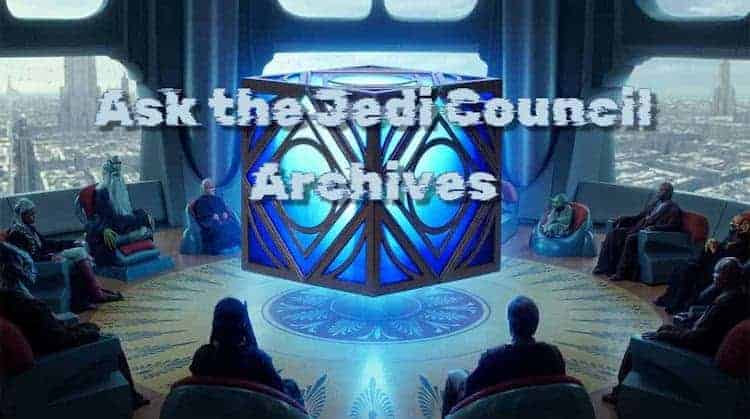
Step Into 2001 — The Jedi Council Is In Session
Welcome to the Ask the Lucasfilm Jedi Council Archives. A feature of *starwars.com no longer directly available. This is not a complete archive in regards to images and such but I have salvaged everything else that I was able to and can now say I have found ALL of the questions that were asked of the esteemed council!!. 
(*Archived here with Permission utilising The Internet Archive Wayback Machine)
This archive compiles Lucasfilm’s public Q&A responses from 2001, offering a snapshot of the studio’s thinking during the early prequel era. The material covers a mix of Jedi training explanations, ILM animation insights, and behind‑the‑scenes production details tied to Episode I and the then‑developing Episode II. Fans asked about lore, filmmaking techniques, continuity, and character development, and Lucasfilm’s answers reflect both the technological transition of the time and the evolving creative direction of the saga.
 Overall, it’s a preserved slice of early‑2000s Star Wars world‑building and production commentary — part lore clarification, part filmmaking education, part prequel‑era time capsule.


January 2001
Nick Gillard: Hayden Christensen was outstanding. We spent a great deal of time rehearsing. He has a totally individual style, beautiful balance and frightening speed — everything you would expect. Q : Where did the majority of ILM animators learn their computer animation skills? Were most self-taught or is formal training and coursework the norm? Rob Coleman: All of the animators working at ILM have a background in some form of animation. They have worked in either puppet animation, cel animation or computer animation. Many of them were interested in computer animation prior to coming to ILM, some had dabbled on their own machines and some of the newer animators had some training in school. You have to remember that good courses in computer animation at colleges and universities have come along fairly recently. No matter what form of animation you have on your reel, whether puppet, cel or computer, we are looking for raw talent. When viewing your reel we ask ourselves some questions. How well do you animate the characters? Do the characters have weight? Do they have appeal? How well are the scenes staged? Do you seem to understand performance? We have a great computer training department here at ILM so we are not necessarily worried about an individual’s computer skills. If needed, we’ll train them on the computer when they get here. It is much easier to teach a talented animator about computers than a computer person about animation. Of course if a candidate has both computer and animation skills, then that is great. My advice would be to focus on demonstrating your animation skill; that is what we’re really interested in.
Stuart Lowder: All of the Star Wars animation crew have either a formal background in animation or extensive work experience in the professional animation field. Many of the animators came from schools such as Sheridan College, CalArts or Ringling, or have a traditional cel animation or stop motion background with feature film and television experience. Many come from studios like Amblin, Disney, Pixar, Warner Bros. and PDI. In general, ILM is interested in experienced animators who have a desire to use the computer as their animation tool. If someone has proven animation talent, we would consider teaching them the technical information that they need to know. Stuart Lowder is currently the manager of the computer graphics animation department at ILM. The department consists of approximately sixty very talented and diverse animators. Q : In Episode IV after the Battle of Yavin there are four ships: Luke and Wedge in their X-wings, Han in the Falcon, and a Y-wing fighter. Who was in the remaining Y-wing ship?
The strategy guide for the game continues that story and places Farlander aboard a Y-wing fighter during the final assault on the Death Star. Farlander survives the battle, making him a good candidate for the Y-wing pilot seen at the end of the film. Q : Who is your favorite artist?
Q : Episode II appears to be more character driven. Does that mean less work for you?
Doug Chiang: There will be two new planets, and we will be developing Coruscant and Naboo further. You will see parts of Coruscant and Naboo that we have never seen before. There will be some neat surprises.
Gavin Bocquet: It all depends where George decides the next Episode will be set. Once we see the script, George may already have seen some locations that he would like to use. But it is too early to say whether it could be Mexico. February 2001
Steve Sansweet: In the film Star Wars: A New Hope, the comm-unit designation for Luke Skywalker’s X-wing starfighter during the Battle of Yavin was Red Five. Some confusion arises because the novelization of the film, which was published six months before the movie opened and completed considerably before the film’s final editing, had different designations for squadron member call-signs.
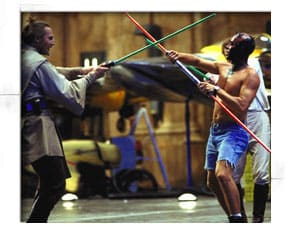
Nick Gillard: It’s not too difficult. We are lucky on Star Wars that we get plenty of rehearsal time with the actors. That, coupled with the fact that they want to learn how to fight with lightsabers anyway…
Q : I heard about the digital satellite broadcast of Episode I to select theaters. How did this trial run go, and will it be implemented on a larger scale for Episode II?
We were pleased with the results, and clearly the audiences were as well. We’re hopeful that we can increase the number of digital showings for Episode II because there are so many advantages. The main advantage is the quality of the presentation and the fact that, unlike physical film, the 100th showing will look every bit as good as the first showing. There are also other benefits, which include the cost of distribution and the cost of manufacturing thousands of reels of film. There’s a huge positive environmental impact along with that, as well. Whether the movie crosses over high-speed data lines, arrives via satellite, on physical disc media, or some combination of the three — I think that’s still up in the air. It will be interesting to see how it plays out while considering both cost and security factors. Q : Do you feel George is pushing yourself and ILM even further with the Episode II, or are you sticking to the techniques that were mastered during Episode I production?
And without question, George is greatly pushing us and ILM to new levels. He really is amazing that way — each time we think he can’t push it any more, he raises the bar to a new level. It’s exhilarating to work in that environment. Q : What sounds, if any, from the classic trilogy could be re-used for Episodes I or II?
Q : While working on Episode II designs, did you keep from thinking ahead to Episode III, or was it necessary for you to do so?
March 2001 Q : What can you tell us now that you’ve seen Hayden Christensen act?
Q : Does one have to be artistically-inclined to succeed in your field of expertise (do you have to be an artist)?
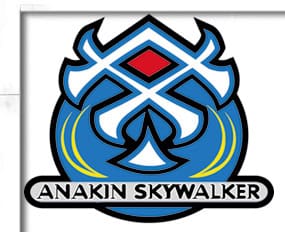
Doug Chiang: The “Skywalker Emblem” originated from George’s request for alien graphics to decorate each of the Podracers. In keeping to the style of “hot rods” influence, we created a Tatooine alphabet and numbering system. The symbol that we designed for Anakin was going to be his racing number, but eventually it became the symbol for Anakin.
Q : What are the basic differences between 2-D and 3-D animation?
April 2001 Q : In Star Wars, why does the Death Star go around the planet Yavin to blow up the fourth moon when it can simply blow up Yavin first (as it did Alderaan) and then the fourth moon without wasting any time?
Q : How many iterations of character, mechanical and technical concepts do you tend to do before you ‘find’ your final designs?
Nick Gillard: Most martial arts are too strict — gymnastics lend themselves more to Jedi-style combat. There is always enough information in the script to write a fighting style that fits the character perfectly. May 2001 Q : When will the new databank section of starwars.com be completed?
“The new starwars.com databank is a work in progress, and will be frequently updated with new material. You’ll note that the species and creatures entries aren’t there yet, but that will soon change. As the databank grows, you’ll find out new information about your favorites, as well as get a first glimpse at new characters, vehicles, droids and more from Episode II. Also, there will be entries dedicated to things only seen in the Expanded Universe of Star Wars comics, books and games. Keep checking the databank section for new updates, and enjoy the newly revamped entries that are already there.” Q : Which was your favorite animated scene in Episode I?
Doug Chiang: It would have to be the AT-AT battle in the beginning of Empire. That scene contained everything that inspired me as a kid to the Star Wars universe – great design, action, drama, and heroics. It is brilliant. Q : Why didn’t Qui-Gon and Obi-Wan testify on the Queen’s behalf during the senate hearings? They had proof of the Trade Federation invasion. They were there!
The Jedi didn’t testify because they weren’t really supposed to be there. (“The chancellor should never have brought them into this,” says Sidious). Valorum, knowing full well of the Senate’s inefficiencies, didn’t bring the matter of sending Jedi ambassadors to a vote. So, he took it under his own authority to send the Jedi to Naboo. Already mired in “scandal and baseless accusation,” Valorum couldn’t bring up the unauthorized Jedi mission for fear of political recrimination. As it turned out, Valorum was ousted from office anyway, and the Jedi were preoccupied with Qui-Gon’s claims of finding the Chosen One of ancient prophecy. Q : You have made mention of the various software tools you use to create the 3D models for animatics. What hardware do you use for your render farm and real-time rendering?
That said, technology is always interesting so I’ll answer your question: On Episode I, we used high-end Macintosh computers running Electric Image, Adobe After Effects, Commotion, PhotoShop, etc. On Episode II, we’ve added Alias Wavefront’s Maya software to our toolbox and it’s working out fantastically. We’re using it quite a bit.
Steve Sansweet: Not necessarily. Remember, it’s a huge galaxy. Just because something isn’t mentioned doesn’t mean that it has disappeared. Neither Yavin nor Dantooine are mentioned in Episodes V and VI, and those places are still around. Similarly, Nepal isn’t mentioned in Temple of Doom or Last Crusade, but it still exists.
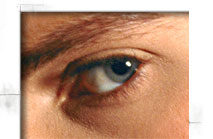
Robin Gurland: Hayden has blue eyes.
Q : Why does it take three years between the release of the new Star Wars movies?
Episode I actually took us 5 years, including one serious year of massive conceptual art design which affected not only Episode I but also Episode II and even III to a certain degree. This one took three years, one year less than the real pre-production time we had on Episode I. For Episode III, we’re trying to start the script now and move back to about four years of total time because in reality that’s how much time we need. They’re very complicated to make. It takes 18 months just to do the effects, and it takes six months to prepare for those effects, so that’s two years right there. It takes us basically seven months to prepare and four months to shoot… that’s another year. And then it takes us a year to conceptualize and have everything together to make the necessary commitments for locations. We don’t just shoot in the studio, we stop in five different countries, we have to get permissions, schedule, just mammoth things. July 2001 Q: I am interested in your concept behind the propulsion system of the Gungan bongo sub. Did I read somewhere that Japanese researchers are involved in a project somewhat similar?
Nick Gillard: In Episode II, Natalie Portman’s character is much more aggressive. And although I had a very good stunt double there, Natalie insisted on doing all her own stunts. She was quite fearless.
Robin Gurland: Neither Christopher Walken nor Garbriel Byrne were ever cast in Episode II… it was a figment of a fan’s imagination.
Jocasta Nu: The answer to the first one is simple, young Padawan. Luke did not have his lightsaber on his person when he infiltrated the Death Star. He left it aboard the Millennium Falcon. You’ll note it’s never seen dangling from the stormtrooper belt he appropriated. As for the second part, that would be Han Solo who shouts out “3263827!” in response to Luke’s query, “Where are we? Q: I believe you said that you developed twelve positions for the Jedi fighting style. Traditional theatrical combat has eight. What are the other four?
I hope this clears up any problems. Q: If Anakin is too old to begin the training at nine, why was it okay to train Luke who was much older?
August 2001 Q: How much direction are you given with the animatics? Are there times when watching parts of Episode I where you could say, “Hang on, I directed that scene”?
Q: Why did Luke marry Mara Jade? I thought he was in love with Callista. I thought Mara was dating Lando.
As for Lando and Mara, though Calrissian probably entertained thoughts of a less-than-professional relationship with the former Emperor’s Hand, Mara didn’t reciprocate such notions. The two traveled together on business for a time, during which Mara posed as Lando’s girlfriend, but it was just a cover story.
Rick McCallum: No, not yet. But I’m looking forward to going to search for locations when the script is far enough along.
Jocasta Nu: Obviously, I am not the real Jocasta Nu, who like so many of our brethren was lost when the dark times befell the Republic. I am the gatekeeper to this online holocron of information, a repository of lore about our galaxy. I am a simulation based on the revered Jedi librarian, here to offer you guidance and answer your questions.
Steve Sansweet: While issues like these are often best left to each individual’s “point of view”, here’s what LucasBooks’ Chris Cerasi had to say…
When it comes to absolute canon, the real story of Star Wars, you must turn to the films themselves – and only the films. Even novelizations are interpretations of the film, and while they are largely true to George Lucas’ vision (he works quite closely with the novel authors), the method in which they are written does allow for some minor differences. The novelizations are written concurrently with the film’s production, so variations in detail do creep in from time to time. Nonetheless, they should be regarded as very accurate depictions of the fictional Star Wars movies. The further one branches away from the movies, the more interpretation and speculation come into play. LucasBooks works diligently to keep the continuing Star Wars expanded universe cohesive and uniform, but stylistically, there is always room for variation. Not all artists draw Luke Skywalker the same way. Not all writers define the character in the same fashion. The particular attributes of individual media also come into play. A comic book interpretation of an event will likely have less dialogue or different pacing than a novel version. A video game has to take an interactive approach that favors gameplay. So too must card and roleplaying games ascribe certain characteristics to characters and events in order to make them playable. The analogy is that every piece of published Star Wars fiction is a window into the ‘real’ Star Wars universe. Some windows are a bit foggier than others. Some are decidedly abstract. But each contains a nugget of truth to them. Like the great Jedi Knight Obi-Wan Kenobi said, ‘many of the truths we cling to depend greatly on our point of view.’ Returning to the question at hand. Yes, Star Wars Gamer is part of continuity, though as game material, there is room for interpretation. Only specific articles marked with the ‘Infinities’ logo within the magazine should be considered out of continuity. Fans of the old monthly Marvel Star Wars comic will be heartened to know that LucasBooks does indeed consider them part of continuity. Decades of retrospect haven’t been kind to all the elements of the comic series, but the characters and events still hold weight and are referenced in newer material whenever possible.
Q: Which two handmaidens accompany Queen Amidala in Palpatine’s senate box?
During the senate session that saw Chancellor Valorum topple from power, Queen Amidala was accompanied by Eirtaé and Rabé. Sabé presumably stayed at Palpatine’s residence. Q: Is it still difficult to create realistic CG water or hair, or other similarly complex objects?
But, we do learn a lot every time we do certain things. For example, we’ve been doing hair for long enough now that we have some pretty standardized ways of handling the types of hair and fur that we need to create most often. When I was working on 101 Dalmatians I spent several months working out the look of puppy fur, but nowadays we are turning around some creatures with fur in a matter of weeks. Likewise, Perfect Storm was a watershed (get it? 😉 in our ability to create water effects: We had to try so many different things that we ended up with a pretty big toolbox. That same toolbox is serving us well for more recent projects with CGI water, such as A.I.
Q: What are the differences between your stunt work on Indiana Jones and the Star Wars films?
Whereas. “Star Wars” is hunched over a computer, Elegant, No room for error, Exact, Perfect, Economic type stunts. Both very different, Both very rewarding! September 2001
David Dozoretz: There is a much higher demand for pre-visualization today and it continues to grow. Companies such as Persistence of Vision Digital Entertainment are popping up all over the place to provide filmmakers with pre-vis services and Hollywood is really embracing it. Episode I was really groundbreaking in the amount and extent to which animatics were utilized.
Jocasta Nu: While it does appear that Dash Rendar’s starship, the Outrider, is destroyed in the novel Shadows of the Empire, the video game reveals a different fate. It was only a trick of timing and perspective. The Outrider survived the final battle over Coruscant, and Dash escaped. He laid low for quite some time, not reappearing until the comic series Shadows of the Empire: Evolution. Dash Rendar will not appear in Episode II. Q: Why was Anakin too old to be trained as a Jedi? While this basic question was answered recently by Madame Jocasta Nu, George Lucas addresses the issue with a slightly different spin in the audio commentary of the upcoming Phantom Menace DVD
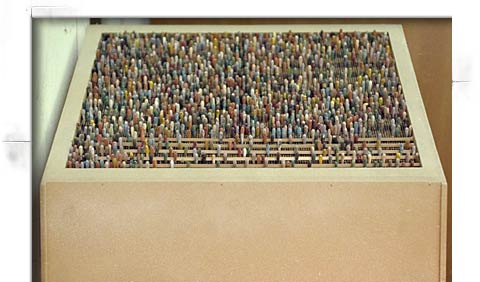
“Plotwise, we’re dealing with the insistence of Obi-Wan in taking on this young kid and training him, even though, in theory, the child should have been trained by Yoda until he was about seven or eight years old. And then when he was seven or eight, he’d be given a Jedi. He’d become the Padawan learner to a Jedi. So here we’re having Qui-Gon wanting to skip the early training and jump right to taking him on as his Padawan learner, which is controversial and ultimately the source of much of the problems that develop later on.” Q: Whose idea was it to use colored Q-tips as fans in Phantom’s Podrace Arena Grandstand scenes?
Michael Lynch joined Industrial Light & Magic as a modelmaker creating miniature buildings for the film Backdraft. As a Model Shop Project Supervisor, Lynch is responsible for the bidding, methodology and overseeing the execution of the model shop projects.
Another answer comes from behind the scenes. ILM model-maker Bill George was most responsible for the B-wing fighter models. As he explains, when he received the early sketches of the two new Alliance starfighters for Return of the Jedi, one ship was called “A craft”, while the other was called “B craft.” He surmises that the “A” and “B” were just the way the production crew differentiated the ships. Perhaps it was an accident that the A-wing does have a passing resemblance to an A. The B-wing moniker stuck well, since some in the modeling crew took to calling the odd-shaped craft the “Bill-wing”, in reference to Bill George.
Nick Gillard: I think there will always be a need for real pyrotechnics on film sets. It is difficult for an actor to react to someone saying “NOW.” Q: In Episode IV, Luke wants to join to the Academy. Surely he wasn’t planning to join an Imperial military institution just as a means of leaving Tatooine? Could you explain exactly what this academy is?
Biggs Darklighter joined the Academy, and received a comission aboard a non-combat vessel, the freighter Rand Ecliptic. Luke Skywalker assured Biggs that when he joined the Academy, he wouldn’t be drafted into the Imperial starfleet, though it is unclear as to how Luke intended on avoiding such a fate. October 2001 Q: What is the difference between bluescreen and greenscreen?
Jocasta Nu: While Force intuition did play a great role in the construction of Luke Skywalker’s new blade, all the necessary technical information was contained in the place where he built it: Obi-Wan Kenobi’s hut on Tatooine.
ILM: We’re doing all of the miniature shooting in HD, not film. We’re using a newer, smaller version of the Sony camera so that it can fit into tighter spaces, but it’s otherwise the same equipment we used for first unit. John Knoll is a Visual Effects Supervisor on The Phantom Menace and Attack of the Clones. November 2001
Jocasta Nu: The standard measurements used in the galaxy are derived from the local measurements found on Coruscant. A standard day consists of 24 hours. There are five standard days in a standard week. There are seven standard weeks in a standard month. A standard year is 368 standard days long, which breaks down to ten standard months plus three “fete weeks” and three more holidays, all devoted to traditional celebrations, festivals and observances.
In the Star Wars ongoing comic series, this discrepancy is explained by Mace and fellow Jedi Master Eeth Koth participating in a Jedi tradition called the Concordance of Fealty. “Master Eeth Koth, I have something to return to you,” says Windu. “It is a product of your own hands which you once entrusted to mine. In returning this lightsaber, I return your trust.” So the weapon that Windu is seen carrying in that publicity still is actually Eeth Koth’s. Q: In the Second Edition of A Guide to the Star Wars Universe (published in 1994) it states that C-3PO was activated 112 years before A New Hope. It also says that Anakin Skywalker was born 55 years before A New Hope. This would have made him 15 years old in Episode I. What’s the deal?
As a side note, the Star Wars: Episode I Visual Dictionary reveals that the body frame Anakin found in constructing C-3PO is over 80 years old, making the 112 year date accurate… from a certain point of view. December 2001
Jocasta Nu: The word “executor” means “one who carries out or performs something,” and is pronounced ig-ZEK-yoo-tur. The confusion over pronunciation often stems from the word “executioner.”
Nick Gillard: No, I have never performed a stunt in either movie. But I was a handmaiden in The Phantom Menace.
Jocasta Nu: As explained in a starwars.com article:
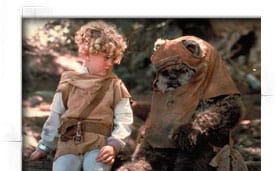
“… Wicket appears to learn English through his association with Cindel. It is likely that the language Cindel was speaking was not Basic, but another language, and that it was translated into English for the benefit of the viewing audience. Thus, Wicket doesn’t understand what Princess Leia is saying when those two meet.”
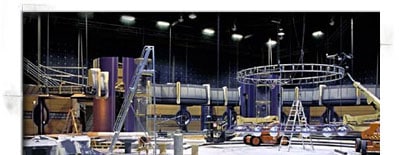
Gavin Bocquet: It’s one of those funny things where for what the scene might be, it’s actually quite a volumetrically big environment.
The script calls for a nightclub at a certain style and we had discussions with George [Lucas] about what he needed to shoot in there. The scene is now a little bit shorter in there, but it didn’t mean that the environment had to be smaller. Just a smaller scene doesn’t mean a smaller environment. And a big scene doesn’t mean big environment. It just depends what’s needed for the script. But I think it’s going to be quite a fun environment. It’s the cantina multiplied by 10 to 20 with 10 to 20 times the number of people we had in there. Q: When does the Queen switch places with the decoy and back again?
Once arriving on Coruscant, it is Sabé (dressed as the Queen) who greets Senator Palpatine and Chancellor Valorum. At Palpatine’s apartments, Padmé and Sabé change places so that it is really the Queen who confers with Palpatine and later addresses the Senate. Amidala remains as the Queen for the return back to Naboo, but once on planet, she and Sabé switch one last time to meet with the Gungans. It is here that the Queen reveals her true identity and Padmé Amidala prostrates herself before the Gungan leader. |
 Q : It appears that you were impressed with Ewan McGregor’s quick grasp of your Jedi fighting style. How did Hayden do?
 Rob Coleman is an Animation Director at ILM. He joined ILM in 1993 to work on The Mask and also worked on Indian in the Cupboard, Star Trek Generations and was animation supervisor/director on Dragonheart, Men in Black and Star Wars: Episode I The Phantom Menace. He graduated from Concordia University in Montreal, Quebec, Canada in 1987 with a BFA in classical film animation. While there, he studied with the world renowned Yugoslavian animator Zlatko Grgic. His next project is directing the animation for Star Wars: Episode II.
 Steve Sansweet: It’s pretty definite that more than just those four ships survived from the Alliance attack on the Death Star; others just aren’t visible on screen. The Y-wing pilot has never been definitively identified. But, if you’re the gambling kind, I’d say the smart money is on Keyan Farlander, a starfighter pilot introduced in the original X-wing game from LucasArts. Back in 1992, LucasArts published a novella starring Farlander that came with some copies of the game.
 Doug Chiang: I don’t have a favorite artist because it’s too hard to identify one specific person. All the artists that I admire are equally important and I’m discovering new artists all the time. Among the artists that have influenced me in the past are Ralph McQuarrie, Norman Rockwell, James Bama, John Stobart, Syd Mead, Frank McCarthy, and Robert Bateman.
 David Dozoretz: There’s tons of work for the animatic crew on Episode II. Even in dialogue scenes, we’re putting in set extensions, creatures, droids, spaceships, etc. George likes to create a “world” in each scene. He designs a rich texture to the film in which the story develops. Besides, despite being very character driven, George has definitely created opportunity in Episode II for some great, never-been-seen-before action sequences. I won’t say anything else!

 Rick McCallum: For the digital projection of Episode I done in four theaters last year, the movie was physically delivered on disc as opposed to delivery via satellite.
 Ben Burtt: Obviously certain reoccurring characters such as Jawas, Tusken Raiders, and Artoo can be reused but added to as necessary in the new episodes. Jedi lightsabers, many lasers, and some environments like Tatooine can be “recycled” where appropriate. However, I am always getting new sounds and new ideas as I go along, and each film adds hundreds of new sound effects. I hope to keep expanding the sonic lexicon already built up over 25 years of sound design for these films.

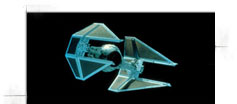
 Robin Gurland: He amazes me every time. He has some tricky, tricky scenes…very complicated scenes. The arc that he’s creating not only has to go through this film but the next one, and there’s a lot of texture to it. And again, the way that this is composed, George writes in these vignettes and you have to really be able to play within a certain scene, but then carry it forth. For an actor who is carrying it forth in one or two films it’s very difficult. It’s a very emotional balance that Hayden’s playing. And he can’t really give away too much on this one, because the next one is really when it’s going to come into play. He is one of the strongest actors I’ve come across in a long, long time. And it’s not just my opinion. People are constantly coming up to me on set and saying “Do you know how good he is?” Yes, I do. And these are other actors. It’s the ultimate compliment when another actor says, “This kid is something!”
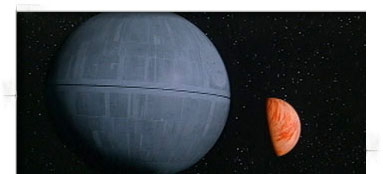
 Q: My friends and I have been debating this forever. Why didn’t Luke use his lightsaber to cut his way out of the Death Star’s garbage masher? And who shouts out the trash compactor number in A New Hope?
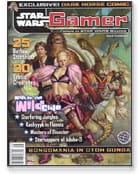 There’s been some confusion of late regarding the ‘Infinities’ symbol, and Star Wars Expanded Universe continuity in general. Terms like “canon” and “continuity” tend to get thrown around casually, which doesn’t help at all.
 In order to allow unlimited freedom of storytelling, the Infinities label has been placed on the anthology series, Star Wars Tales. This means that not only can the stories occur anywhere in the Star Wars timeline, but stories can happen outside continuity. Basically, if an event happens in Tales, it may not have necessarily happened in the rest of the expanded universe. For some stories, the distinction is largely inconsequential. For others, it’s the only way they could exist (for example, there’s a Darth Vader vs. Darth Maul comic coming soon).
 ILM: Sure. Water and hair are great examples of real-world objects that have both very complex motion and very complex appearance. (Other examples are clouds, fire, and smoke.) They also look really different at different sizes: You can instantly tell the difference between an ocean, a lake, and a puddle, or between kitten fur and yak fur. So even though we knew how to do things like the pseudopod from The Abyss or the tidal wave from Deep Impact, doing The Perfect Storm was almost like starting from scratch!
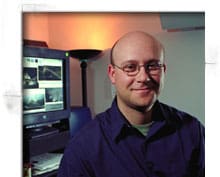 Dan Goldman began working at Industrial Light & Magic in 1992 as an intern in the software department, and has since gone on to become a computer graphics supervisor. His areas of expertise are digital cinematography, shaders and scripting. Most recently, Goldman supervised the modeling and viewpainting, and oversaw the lighting of the digital Andrea Gail, the fishing boat featured in The Perfect Storm. Some of his other recent work can be seen in the terrains created for the Podrace sequence in Star Wars: Episode I The Phantom Menace, as well as extensive work on the scripts and shaders for the supercar sequence in Men in Black.
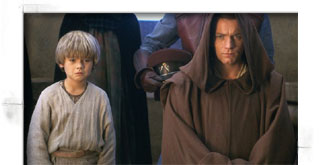

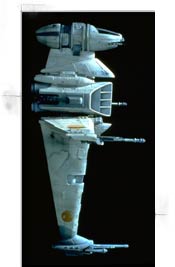 Jocasta Nu: The visual connection of the B-wing fighter to the look of a lower case letter B is admittedly a forced one, and there are a number of other theories as to the source of its name. Some like to think that its blade shape is the source of the ‘B’. Others point to the fact that, in the Expanded Universe, this starfighter was specifically created to combat the Nebulon-B escort frigate.
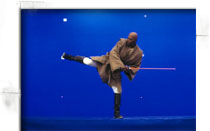
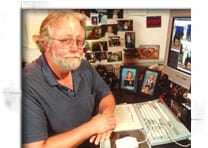 Jeff Doran joined ILM in 1983 for Indiana Jones and the Temple of Doom as an optical lab technician, and was soon promoted to optical compositing camera operator where he operated the optical printer to composite effects for over 20 major feature films. Doran is now compositing supervisor for Star Wars: Episode II Attack of the Clones.

 Jocasta Nu: This is the third lightsaber Mace Windu has been seen bearing since the introduction of his character. His latest blade can easily be explained by the amount of time which passes in between episodes — surely in the ten years that pass between The Phantom Menace and Attack of the Clones, an event occurred which necessitated a change in weaponry. That event has yet to be told.
 A less fantastic explanation exists for the first two lightsabers that Mace Windu wore for The Phantom Menace. When it came time for actor Samuel L. Jackson to pose for a publicity shot, the lightsaber he specifically requested was not available. When that image was republished, the correct lightsaber was composited onto Mace Windu’s belt.



Please Share this post:
- Share on X (Opens in new window) X
- Share on Tumblr (Opens in new window) Tumblr
- Share on Mastodon (Opens in new window) Mastodon
- Share on Bluesky (Opens in new window) Bluesky
- Share on Facebook (Opens in new window) Facebook
- Print (Opens in new window) Print
- More
- Email a link to a friend (Opens in new window) Email
- Share on Threads (Opens in new window) Threads
- Share on Reddit (Opens in new window) Reddit
- Share on Pinterest (Opens in new window) Pinterest
- Share on LinkedIn (Opens in new window) LinkedIn
- Share on WhatsApp (Opens in new window) WhatsApp
- Share on Nextdoor (Opens in new window) Nextdoor
- Share on Telegram (Opens in new window) Telegram